
What are the main types of abdominal hernias?
The main abdominal and groin hernia types are inguinal, femoral, umbilical, epigastric, incisional and other ventral hernias. Doctors name them mainly by location and the weak point involved. A hiatal hernia is different because it occurs inside the body where the stomach moves through the diaphragm.
An abdominal hernia is tissue or part of an organ pushing through a weak area in the muscle or connective tissue that normally contains it. It may appear as a bulge that becomes clearer while standing, coughing, lifting or straining, but not every abdominal lump is a hernia.
Fast decision rule: note where the bulge is, whether it changes with coughing or lying down, whether it is painful or stuck, and whether vomiting, fever, color change, bloating or bowel symptoms are present. A stable bulge needs a planned surgical review; a painful stuck bulge with illness needs urgent care.
How can location help identify the likely hernia type?
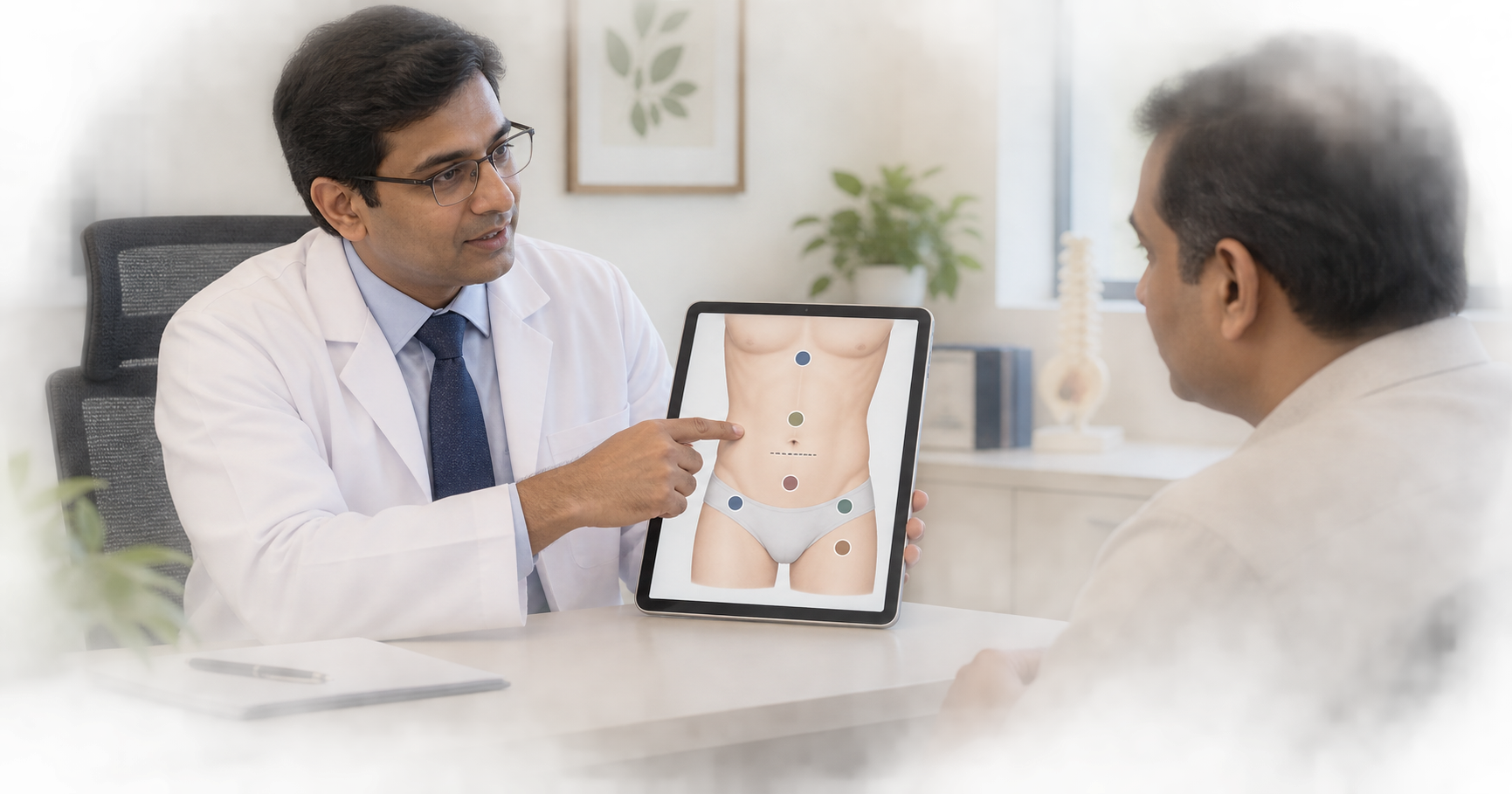
Location narrows the possibilities: groin swelling may be inguinal, a lump just below the groin crease may be femoral, a navel bulge may be umbilical, an upper-midline bulge may be epigastric, and swelling at an old operation scar may be incisional. Location alone cannot confirm the diagnosis.
Patient comparison guide: groin—inguinal hernia; upper inner thigh or below the groin crease—femoral hernia; at the belly button—umbilical hernia; between the breastbone and navel—epigastric hernia; at a previous abdominal incision—incisional hernia; elsewhere through the front abdominal wall—ventral hernia.
The American College of Surgeons describes ventral hernias as defects in the front abdominal wall and distinguishes umbilical, epigastric and incisional locations: https://www.facs.org/for-patients/the-day-of-your-surgery/ventral-hernia-repair/. For a visual location-first guide, also read /articles/above-belly-button-hernia-bhopal and /articles/umbilical-hernia-symptoms-adults-bhopal.
What is the difference between inguinal and femoral hernia?
An inguinal hernia usually appears in the groin above the crease and is more common in men. A femoral hernia usually appears lower, near the upper inner thigh, and is less common but deserves prompt assessment because complications can occur. Patients should not try to classify either type from a photo.
NIDDK explains that an inguinal hernia occurs through a weak area in the lower abdominal wall near the groin: https://www.niddk.nih.gov/health-information/digestive-diseases/inguinal-hernia. NHS guidance explains that femoral hernias appear near the groin or upper inner thigh and are more common in women: https://www.nhs.uk/conditions/femoral-hernia-repair/.
If the main symptom is a groin bulge, use /articles/inguinal-hernia-symptoms-men-bhopal or /articles/femoral-hernia-symptoms-women-bhopal to prepare for consultation. A clinician still needs to distinguish hernia from lymph nodes, lipoma, vascular swelling and other causes.
How do umbilical, epigastric and incisional hernias differ?
Umbilical hernias occur at or close to the navel, epigastric hernias occur in the upper midline between the breastbone and navel, and incisional hernias develop through a weak area at or near a previous operation scar. All three are ventral hernias, but their history and repair planning can differ.
Previous surgery is a crucial clue. An old scar that develops a cough-related bulge months or years later may need assessment for an incisional hernia. Read /articles/incisional-hernia-symptoms-after-surgery-bhopal for the specific scar checklist and bring the earlier operation record if available.
Cleveland Clinic outlines umbilical, epigastric and incisional hernias among common hernia types and notes that symptoms depend on location: https://my.clevelandclinic.org/health/diseases/15757-hernia. The label should guide questions, not self-treatment.
Which hernia symptoms need emergency care?
Urgent warning signs include a suddenly painful bulge that will not go back, rapid enlargement, marked tenderness, red, purple or dark skin, repeated vomiting, fever, abdominal swelling, constipation, inability to pass gas, fainting, confusion or a patient who looks very unwell. These symptoms should not wait for a routine clinic slot.
MedlinePlus notes that a hernia can become trapped or strangulated and that sudden pain, nausea and vomiting can be warning symptoms: https://medlineplus.gov/hernia.html. The American College of Surgeons also advises immediate care for sharp abdominal pain and vomiting with a ventral hernia: https://www.facs.org/for-patients/the-day-of-your-surgery/ventral-hernia-repair/.
Do not repeatedly force a painful stuck bulge inward. Contact the hospital, go to an emergency department or use local emergency services. If severe chest pain, breathing difficulty, collapse, uncontrolled bleeding or confusion is present, emergency care comes before online guidance.
How does a surgeon confirm the type of hernia?
A surgeon usually starts with the symptom history and examination while standing and lying down, sometimes asking the patient to cough or strain. Ultrasound, CT or MRI may be considered when the examination is unclear, the hernia is recurrent, the abdominal wall is complex or another cause must be excluded.
Mayo Clinic explains that inguinal hernia diagnosis is often based on physical examination and imaging may be used when the diagnosis is not readily apparent: https://www.mayoclinic.org/diseases-conditions/inguinal-hernia/diagnosis-treatment/drc-20351553. Testing should answer a clinical question rather than be ordered from a generic online checklist.
Bring the symptom timeline, old operation notes, ultrasound or CT reports, medicine list, blood-thinner details and information about diabetes, cough, constipation and lifting at work. /articles/hernia-ultrasound-vs-ct-scan-bhopal explains why one test is not automatically best for every patient.
Does every abdominal hernia need surgery?
Not every hernia requires immediate surgery, but a hernia does not usually close by itself in an adult. The safer plan depends on type, size, symptoms, reducibility, growth, occupation, previous repair, general health and complication risk. Observation should be an informed decision after surgical assessment.
The American College of Surgeons says watchful waiting may be an option for some adults with reducible, comfortable ventral hernias, while repair is the only definitive way to fix the defect: https://www.facs.org/media/zq4hddzo/ventral_hernia.pdf. That does not mean every painless lump is safe to ignore.
If repair is discussed, /articles/open-vs-laparoscopic-hernia-surgery-bhopal compares approaches and /articles/hernia-mesh-repair-bhopal explains why mesh may enter the conversation. The choice should be individualized; this page does not prescribe an operation.
When should a Bhopal patient book a hernia consultation?
Book a planned consultation when a new abdominal or groin bulge appears, discomfort returns with lifting or coughing, the swelling grows, work is affected, a previous repair site changes or a scan mentions a hernia. Earlier review reduces uncertainty and creates a clear emergency plan even when surgery is not immediately required.
For a stable patient, the practical next step is a diagnosis-first visit through /services/hernia-surgery or /contact. Dr. Rajesh Kanungo evaluates abdominal wall and groin hernias at R.K. Hospital, Indrapuri, Bhopal, with open and laparoscopic options discussed only after examination and report review.
For the visit, write down the bulge location, when it appears, whether it reduces while lying down, pain triggers, previous abdominal operations and any vomiting or bowel symptoms. If warning signs are present, skip the appointment queue and seek emergency care.
Which medical sources support this guide?
This article is patient education, not a diagnosis, prescription, emergency triage tool or substitute for examination. It was cross-checked against American College of Surgeons ventral hernia guidance at https://www.facs.org/for-patients/the-day-of-your-surgery/ventral-hernia-repair/ and https://www.facs.org/media/zq4hddzo/ventral_hernia.pdf, NIDDK inguinal hernia guidance at https://www.niddk.nih.gov/health-information/digestive-diseases/inguinal-hernia, MedlinePlus hernia information at https://medlineplus.gov/hernia.html, NHS femoral hernia guidance at https://www.nhs.uk/conditions/femoral-hernia-repair/, Cleveland Clinic hernia guidance at https://my.clevelandclinic.org/health/diseases/15757-hernia and Mayo Clinic diagnosis guidance at https://www.mayoclinic.org/diseases-conditions/inguinal-hernia/diagnosis-treatment/drc-20351553.
The consistent message is simple: location helps describe a suspected hernia, examination confirms what it is, stable symptoms deserve a planned surgical review, and a painful stuck bulge with vomiting, fever, color change or bowel obstruction symptoms needs urgent care.
Related care options
More patient guides
Can You Live Without a Gallbladder? What Changes After Surgery
Yes. Most people can live a normal life without a gallbladder because the liver keeps making bile. After removal, bile flows directly into the small intestine instead of being stored. Some people notice temporary digestive changes, but persistent or severe symptoms deserve medical review.
Nail Polish Before Surgery: What Should Patients Remove?
Many hospitals ask patients to remove nail polish, gel or false nails before surgery because staff may need access to a natural nail for monitoring and assessment. The safest shortcut is simple: ask the hospital in advance, follow its written instruction, and tell the team if a product or item cannot be removed safely.
Piles Grades 1 to 4: What Changes at Each Hemorrhoid Stage?
Internal piles are graded by how far they prolapse, not simply by pain or bleeding. Grade 1 stays inside, grade 2 comes out and returns by itself, grade 3 usually needs manual reduction, and grade 4 remains outside. The grade helps structure a treatment discussion, but symptoms, examination and overall health still decide the plan.
Common questions
What are the most common types of abdominal hernias?
Common types include inguinal, femoral, umbilical, epigastric, incisional and other ventral hernias. They are mainly named by location, but examination is needed to confirm the type.
How can I tell what type of hernia I have?
The bulge location and whether it changes with coughing or lying down provide clues, but symptoms and photos cannot reliably confirm the type. A surgeon may use examination and selected imaging.
Which abdominal hernia is dangerous?
Any hernia can become urgent if it is suddenly painful, stuck, discolored or associated with vomiting, fever, abdominal swelling, constipation or inability to pass gas. Seek emergency care for these signs.
Which doctor treats abdominal hernias in Bhopal?
A general or laparoscopic surgeon can examine an abdominal or groin bulge, review scans and explain observation, open repair or laparoscopic repair when appropriate.