
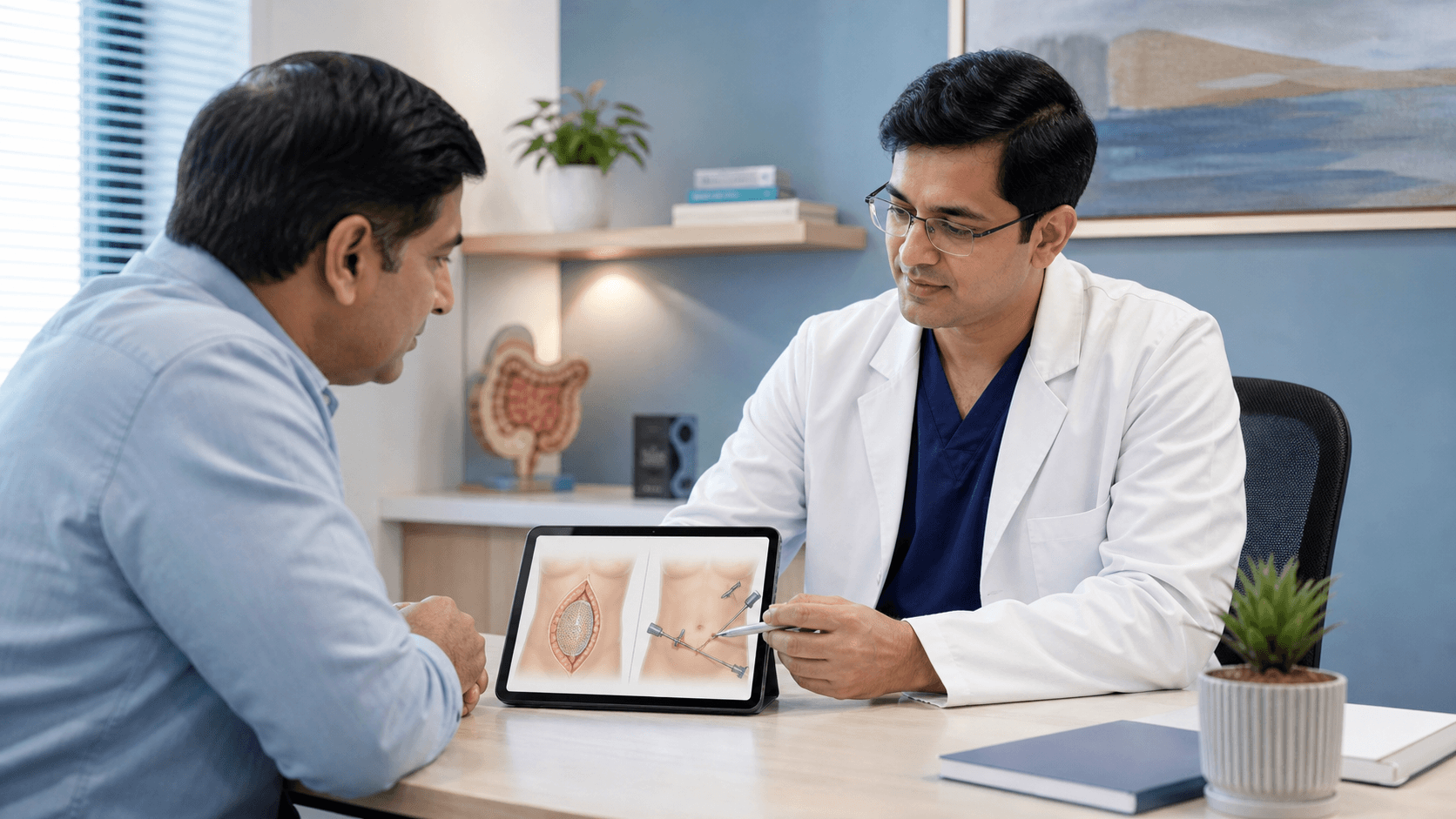
Which is better: open or laparoscopic hernia surgery?
Neither approach is best for every hernia. Open repair can be appropriate for many first-time, large, complex or emergency hernias. Laparoscopic repair can be useful for selected groin hernias, especially when both sides are involved or a hernia has returned after an earlier open repair.
Open hernia repair is surgery through an incision near the hernia. Laparoscopic hernia repair is keyhole surgery through several small abdominal incisions using a camera. Both approaches aim to return displaced tissue and strengthen the weak area; either may involve mesh when clinically appropriate.
Fast decision rule: ask which approach fits your exact hernia and why. A useful answer should mention the hernia type, side, recurrence, previous surgery, anesthesia fitness, urgency, recovery needs and the surgeon’s experience—not just incision size.
How do open and laparoscopic hernia repair compare?
Open repair uses one incision over or near the hernia, while laparoscopic repair uses several small incisions away from it. Laparoscopic repair generally requires general anesthesia. Open repair may use general, regional or local anesthesia depending on the procedure, patient and hospital plan.
Decision table: incision—one local incision versus several keyhole cuts; view—direct view versus camera view; anesthesia—case-dependent versus usually general anesthesia; bilateral groin hernias—either approach may be considered, with laparoscopy often discussed; previous open repair—laparoscopy may offer a different tissue plane; large, complicated or emergency hernia—open repair may be preferred in some cases.
The NHS describes open and keyhole approaches and notes that the choice depends on factors including the hernia, general health and surgeon experience: https://www.nhs.uk/tests-and-treatments/inguinal-hernia-repair/. The American College of Surgeons also compares open and laparoscopic repair for patient decision-making: https://www.facs.org/for-patients/the-day-of-your-surgery/hernia-repair/.
Does laparoscopic hernia surgery mean less pain and faster recovery?
Some patients have less early wound discomfort and return to normal activity sooner after laparoscopic groin hernia repair, but recovery is not guaranteed to be faster. Hernia size, repair complexity, pain response, work demands, diabetes, smoking, obesity and complications can change the timeline.
A 2023 international guideline update reported advantages for laparo-endoscopic repair in selected primary unilateral inguinal hernias when expertise and resources are available, including less postoperative and chronic pain; it also stresses surgeon experience and patient selection: https://academic.oup.com/bjsopen/article/7/5/zrad080/7325871.
Do not choose an operation from a promise of “back to work in a few days.” Ask separately about walking, stairs, driving, desk work and lifting. The hernia surgery recovery guide at /articles/hernia-surgery-recovery-time-bhopal gives a practical follow-up checklist.
When might laparoscopic hernia repair be discussed?
Laparoscopic repair may be discussed for selected inguinal hernias, hernias on both sides, or a recurrent groin hernia after previous open repair. It may also be considered when the surgeon expects that a posterior view of the groin will help the repair plan. For the extra questions raised by two-sided disease, read /articles/bilateral-inguinal-hernia-surgery-bhopal.
SAGES patient information explains that both open and laparoscopic inguinal hernia repair are established options and that prior operations, overall health and hernia characteristics affect selection: https://www.sages.org/publications/patient-information/inguinal-hernia-repair-surgery-sages-patient-information/.
Laparoscopy is not automatically suitable if general anesthesia risk is high, the abdomen has complex scar tissue, the hernia is very large, bowel obstruction or strangulation is suspected, or local expertise and facilities are not appropriate. These are surgeon-assessment questions, not home decision rules.
When might open hernia repair be discussed?
Open repair may be discussed for a first-time one-sided hernia, a large or complex abdominal wall hernia, some patients who may not suit general anesthesia, and urgent cases where direct access is useful. It remains a standard repair, not an outdated option.
The right open technique still varies. The surgeon may discuss tissue repair or mesh reinforcement based on the hernia, contamination risk and patient factors. For a neutral explanation of reinforcement questions, read /articles/hernia-mesh-repair-bhopal.
A smaller skin incision is only one outcome. The more important goals are safe anesthesia, durable repair, acceptable pain, protection of nearby structures and a recovery plan that matches your job and health.
Do recurrence and complication risks differ?
Both approaches can have recurrence, bleeding, infection, fluid collection, numbness, persistent pain, injury to nearby structures or anesthesia complications. Results depend heavily on the hernia type, technique, surgeon experience, patient health and follow-up—not the label “open” or “laparoscopic” alone.
The European Hernia Society guideline update emphasizes tailored treatment and recommends that surgeons and patients consider expertise, resources and individual characteristics. The ACS patient guide similarly presents benefits and risks for both approaches rather than naming one universal winner.
If a bulge has returned after an earlier repair, bring the old operation note and mesh details if available. Read /articles/recurrent-hernia-after-surgery-bhopal, then book an examination rather than assuming the same approach should be repeated.
What should you ask a hernia surgeon before deciding?
Ask for a recommendation tied to your findings: What type of hernia is this? Is it reducible? Is it on one side or both? Is imaging needed? Why do you recommend open or laparoscopic repair? Is mesh likely? What anesthesia is planned? What are your common complications and follow-up steps?
Consultation checklist: carry ultrasound or CT images and reports, previous operation papers, medicine and allergy lists, diabetes and blood-pressure records, blood-thinner details, smoking history, and a note describing lifting at work. Ask when you may walk, drive, climb stairs, work and lift again.
For diagnosis-first review in Bhopal, use /services/laparoscopic-surgery to understand the service and /contact to book a consultation with Dr. Rajesh Kanungo at R.K. Hospital, Indrapuri. This is patient education, not a personalized surgical recommendation.
Which hernia symptoms need emergency care?
Seek urgent medical care if a hernia becomes suddenly very painful, hard, tender, red, purple or dark, cannot be pushed back, or occurs with repeated vomiting, fever, abdominal swelling, inability to pass stool or gas, fainting, confusion or rapid deterioration.
NIDDK warns that an incarcerated or strangulated inguinal hernia can interrupt blood supply and needs immediate medical care: https://www.niddk.nih.gov/health-information/digestive-diseases/inguinal-hernia. Mayo Clinic lists nausea, vomiting, fever, sudden worsening pain and color change as warning signs: https://www.mayoclinic.org/diseases-conditions/inguinal-hernia/symptoms-causes/syc-20351547.
Do not wait for a routine appointment or compare surgical methods online when these signs appear. Go to the nearest emergency department or call local emergency services. The focused warning-sign guide at /articles/strangulated-hernia-symptoms-bhopal explains what to carry and report.
Which medical sources support this comparison?
This guide was cross-checked against NHS inguinal hernia repair guidance at https://www.nhs.uk/tests-and-treatments/inguinal-hernia-repair/, American College of Surgeons patient information at https://www.facs.org/for-patients/the-day-of-your-surgery/hernia-repair/, SAGES patient information at https://www.sages.org/publications/patient-information/inguinal-hernia-repair-surgery-sages-patient-information/, the 2023 HerniaSurge guideline update at https://academic.oup.com/bjsopen/article/7/5/zrad080/7325871, and NIDDK and Mayo Clinic emergency guidance linked above.
Medical evidence supports shared, case-specific selection rather than a universal winner. A surgeon must examine the hernia and review health, anesthesia and previous-operation factors before recommending observation, open repair, laparoscopic repair or emergency treatment.
Related care options
More patient guides
Nail Polish Before Surgery: What Should Patients Remove?
Many hospitals ask patients to remove nail polish, gel or false nails before surgery because staff may need access to a natural nail for monitoring and assessment. The safest shortcut is simple: ask the hospital in advance, follow its written instruction, and tell the team if a product or item cannot be removed safely.
Piles Grades 1 to 4: What Changes at Each Hemorrhoid Stage?
Internal piles are graded by how far they prolapse, not simply by pain or bleeding. Grade 1 stays inside, grade 2 comes out and returns by itself, grade 3 usually needs manual reduction, and grade 4 remains outside. The grade helps structure a treatment discussion, but symptoms, examination and overall health still decide the plan.
Appendix Burst Symptoms: When Abdominal Pain Is an Emergency
A burst appendix is a medical emergency. Possible warning patterns include abdominal pain that becomes severe or spreads across the abdomen, marked tenderness, a swollen or rigid abdomen, repeated vomiting, fever, weakness, confusion or breathing difficulty. Pain may briefly ease before becoming widespread, so sudden relief does not prove the danger has passed.
Common questions
Is laparoscopic hernia surgery better than open surgery?
Not for everyone. Laparoscopic repair may offer less early pain and faster activity return in selected patients, while open repair may suit other first-time, large, complex, anesthesia-risk or emergency cases.
Does laparoscopic hernia surgery always use mesh?
Laparoscopic inguinal hernia repair commonly uses mesh, but the repair plan depends on the hernia, contamination risk, technique and surgeon assessment. Ask what is planned and why.
Can an inguinal hernia on both sides be repaired laparoscopically?
Laparoscopic repair is often discussed for bilateral inguinal hernias because both groins can be assessed through the same keyhole approach, but suitability still requires examination and anesthesia assessment.
When is a hernia an emergency?
Seek emergency care for a suddenly painful or stuck bulge, red or dark color change, repeated vomiting, fever, abdominal swelling, inability to pass stool or gas, fainting, confusion or rapid deterioration.