
Should nail polish be removed before surgery?
Remove nail polish before surgery if your hospital tells you to. Many surgical units prefer at least one natural, uncovered fingernail because staff may use a fingertip pulse oximeter and may inspect nail-bed colour. Rules differ by hospital, operation and monitoring plan, so confirm rather than guessing.
Nail polish before surgery means regular varnish, gel colour, acrylic or other artificial nail products present when a patient arrives for an operation. These products do not automatically make surgery unsafe, but they may interfere with local preparation rules or make a natural nail harder to see.
Fast decision rule: call the hospital before admission and ask one exact question—should all polish, gel and artificial nails be removed, or is one clear fingernail enough? Follow that answer. Do not delay urgent care just to remove a cosmetic product.
Why can nail products matter during an operation?
Nail products can matter because oxygen monitoring is often performed with a pulse oximeter placed on a finger, and clinicians may also want an unobstructed view of the nail bed. Modern monitors have alternatives and staff can choose another site, but patients should not assume every product or monitor behaves the same way.
A pulse oximeter is a small device that estimates blood oxygen saturation and pulse rate, commonly using a sensor on a fingertip. The US Food and Drug Administration explains that readings have limitations and must be interpreted with symptoms and other clinical information: https://www.fda.gov/medical-devices/safety-communications/pulse-oximeter-accuracy-and-limitations-fda-safety-communication.
NHS surgery-preparation guidance notes that patients may be asked to remove nail varnish or false nails before surgery: https://www.nhs.uk/tests-and-treatments/having-surgery/preparation/. That is a preparation instruction, not proof that nail colour alone determines whether an operation can proceed.
What about gel nails, acrylic nails and nail extensions?
Gel nails, acrylic nails and extensions can be harder to remove on the morning of surgery. Ask early whether every artificial nail must come off or whether the hospital needs one or more natural nails available. Do not tear, pry or aggressively file an artificial nail if that could injure the skin.
Decision table: regular varnish is usually easiest to remove at home if instructed; gel polish may need planned removal; acrylic or extensions may need professional removal; a painful, infected or recently injured nail should be disclosed rather than concealed; emergency surgery should never be delayed for cosmetic removal.
If the operation is soon and removal is difficult, call the hospital. State what product is present, which fingers are covered and whether any finger has broken skin, redness, swelling, discharge or pain. The treating team can decide what is necessary for its equipment and procedure.
Should jewellery, piercings and valuables be removed too?
Leave rings, chains, earrings, watches and unnecessary valuables at home unless the hospital gives different instructions. Jewellery may create problems with positioning, swelling, skin preparation, equipment or secure storage. Tell the team in advance about a piercing that cannot be removed safely or an item with religious significance.
The American Society of Anesthesiologists advises patients to ask what should be removed before surgery and to plan for personal items such as glasses, contact lenses and hearing aids: https://madeforthismoment.asahq.org/preparing-for-surgery/prep/preparing-for-surgery-checklist/.
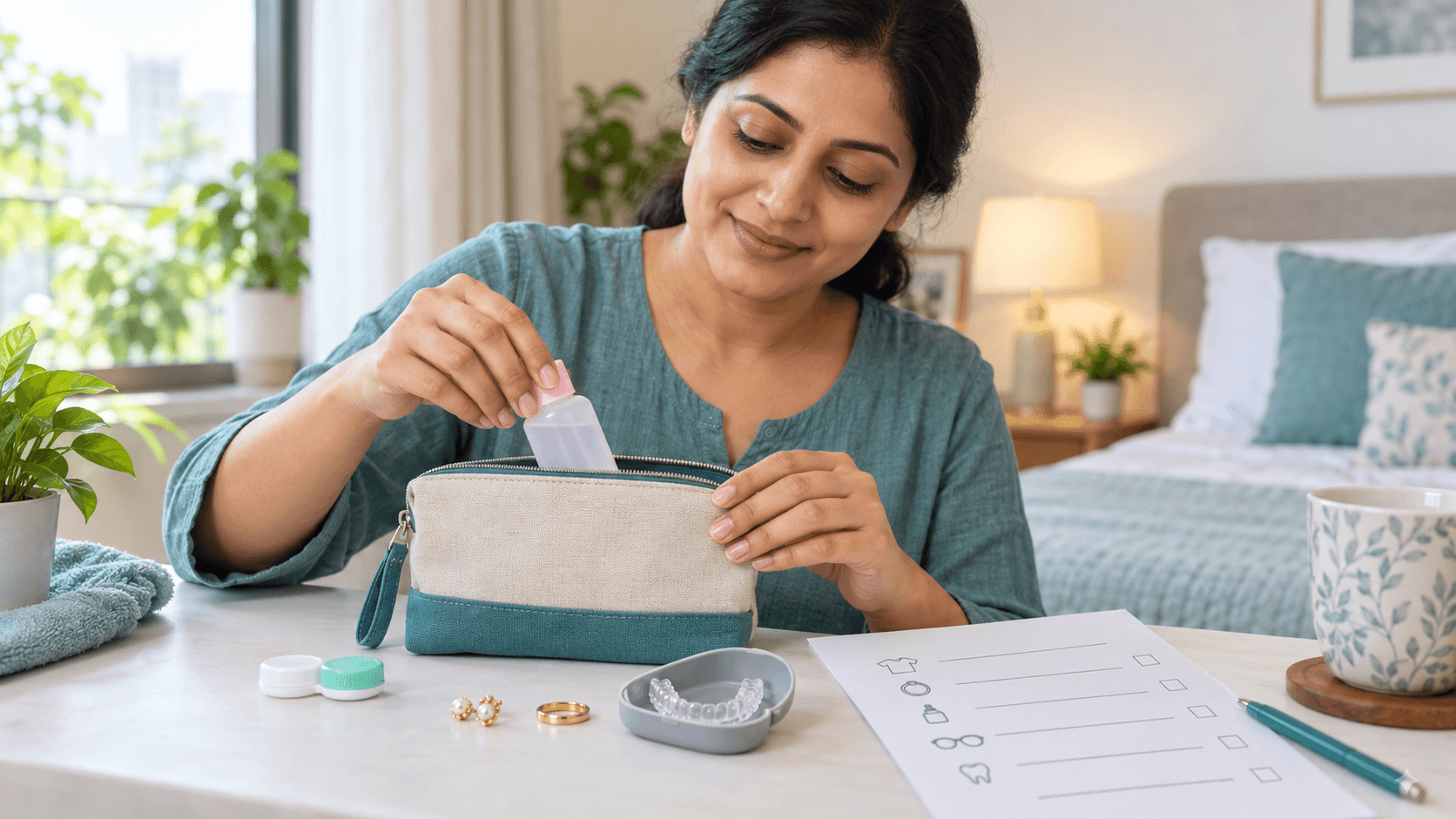
Use one labelled pouch for permitted removable items and hand it to the responsible attendant at the agreed time. For the full clothing and footwear plan, read /articles/what-to-wear-for-laparoscopic-surgery-bhopal. For the report, medicine and admission checklist, use /articles/day-of-surgery-checklist-bhopal.
What should happen to contact lenses, dentures and hearing aids?
Tell staff about contact lenses, removable dentures, hearing aids, spectacles and other assistive devices. You may need some items for communication or mobility before the procedure, but staff may ask you to remove them before anaesthesia. Bring clean, labelled cases rather than wrapping items in tissue.
MedlinePlus day-of-surgery guidance advises patients not to wear contact lenses and to bring storage cases for glasses, dentures or other removable items: https://medlineplus.gov/ency/patientinstructions/000578.htm. Your hospital instruction takes priority because timing and storage arrangements can differ.
Practical checklist: spectacles case, lens case, denture box, hearing-aid case, item labels and one attendant who knows where everything is. Mention loose teeth, dental caps, removable plates or mouth jewellery to the anaesthesia team because airway planning may matter.
Can makeup, lotion, deodorant or hair products be used?
Hospitals may ask patients to arrive without makeup, perfume, body lotion, deodorant or hair products, especially near the planned surgical area. The exact rule varies. Follow the bathing and skin-preparation instructions you were given, and do not add antiseptics, creams or hair removal that the team did not request.
Do not shave the planned surgical site on your own unless specifically instructed. The Centers for Disease Control and Prevention advises patients not to shave near where surgery will occur because shaving with a razor can irritate skin and make infection more likely: https://www.cdc.gov/surgical-site-infections/about/index.html.
Ask before using religious markings, medicated skin products, adhesive nails or cosmetics that are difficult to remove. A short call before admission is easier than rushed removal after reaching the hospital.
What if surgery is urgent or an item cannot be removed?
Urgent symptoms matter more than nail polish or jewellery. Do not delay emergency care to visit a salon or force off a stuck ring or piercing. Tell the emergency or surgical team immediately what is present and why it cannot be removed; clinicians can assess the safest next step.
Seek urgent medical help for severe or worsening abdominal pain, repeated vomiting, breathing difficulty, chest pain, fainting, confusion, heavy bleeding, jaundice, fever with a very unwell patient or a painful hernia swelling that is stuck. Cosmetic preparation is never a substitute for emergency assessment.
This guide is patient education, not diagnosis, prescription advice or personal surgical clearance. For planned surgery in Bhopal, review /services/laparoscopic-surgery and use /contact to ask Dr. Rajesh Kanungo’s team for the hospital-specific preparation list.
What is the easiest night-before-surgery removal checklist?
The easiest checklist is: confirm the hospital rule; remove instructed nail products without injuring skin; leave jewellery and valuables at home; pack labelled cases for spectacles, dentures or hearing aids; follow the prescribed bathing instructions; and report any item that cannot be removed.
Do not let the cosmetic checklist distract from higher-priority safety tasks. Confirm fasting, medicines, allergies, illness changes, reports, transport and attendant support. /articles/fasting-before-laparoscopic-surgery-bhopal explains why another patient’s food or water timing should not be copied.
The best outcome is not simply bare nails. It is arriving with fewer surprises and a clear written plan for your operation. If any instruction conflicts with this article, follow the treating hospital and ask the team to clarify it.
Which reliable sources support this guide?
This guide was cross-checked against NHS surgery-preparation guidance at https://www.nhs.uk/tests-and-treatments/having-surgery/preparation/, FDA pulse-oximeter guidance at https://www.fda.gov/medical-devices/safety-communications/pulse-oximeter-accuracy-and-limitations-fda-safety-communication, American Society of Anesthesiologists preparation guidance at https://madeforthismoment.asahq.org/preparing-for-surgery/prep/preparing-for-surgery-checklist/, MedlinePlus day-of-surgery guidance at https://medlineplus.gov/ency/patientinstructions/000578.htm, and CDC surgical-site infection guidance at https://www.cdc.gov/surgical-site-infections/about/index.html.
The shared conservative message is to follow local instructions, keep natural nails accessible when requested, disclose items that cannot be removed, protect the skin from rushed removal and never delay urgent care for cosmetic preparation.
Related care options
More patient guides
Piles Grades 1 to 4: What Changes at Each Hemorrhoid Stage?
Internal piles are graded by how far they prolapse, not simply by pain or bleeding. Grade 1 stays inside, grade 2 comes out and returns by itself, grade 3 usually needs manual reduction, and grade 4 remains outside. The grade helps structure a treatment discussion, but symptoms, examination and overall health still decide the plan.
Appendix Burst Symptoms: When Abdominal Pain Is an Emergency
A burst appendix is a medical emergency. Possible warning patterns include abdominal pain that becomes severe or spreads across the abdomen, marked tenderness, a swollen or rigid abdomen, repeated vomiting, fever, weakness, confusion or breathing difficulty. Pain may briefly ease before becoming widespread, so sudden relief does not prove the danger has passed.
Questions to Ask a Hernia Surgeon Before Surgery
Before deciding on hernia surgery, ask the surgeon to confirm the hernia type and urgency, explain whether observation or repair is appropriate, compare open and laparoscopic options, discuss mesh and anesthesia, and give a realistic recovery plan for your work and daily life.
Common questions
Can I wear nail polish during surgery?
Many hospitals ask patients to remove nail polish before surgery so a natural nail is available for monitoring and assessment. Confirm your hospital’s rule because the required number of uncovered nails can vary.
Do gel nails or acrylic nails need to be removed before surgery?
They may need removal. Ask early because gel and acrylic products can take time to remove. Do not injure the nail or skin by forcing them off; tell the hospital if safe removal is not possible.
Why do hospitals ask for no nail polish before surgery?
A natural nail may help staff place or check a fingertip pulse oximeter and inspect nail-bed colour. Monitoring alternatives exist, so the treating team decides what is needed.
Should rings and piercings be removed before surgery?
Hospitals commonly ask patients to remove jewellery and piercings. Leave valuables at home and tell the team in advance if an item is stuck, cannot be safely removed or has religious significance.
Should emergency surgery wait until nail polish is removed?
No. Do not delay emergency assessment or treatment for nail polish, artificial nails or jewellery. Tell the clinical team what is present so they can decide how to manage it safely.