
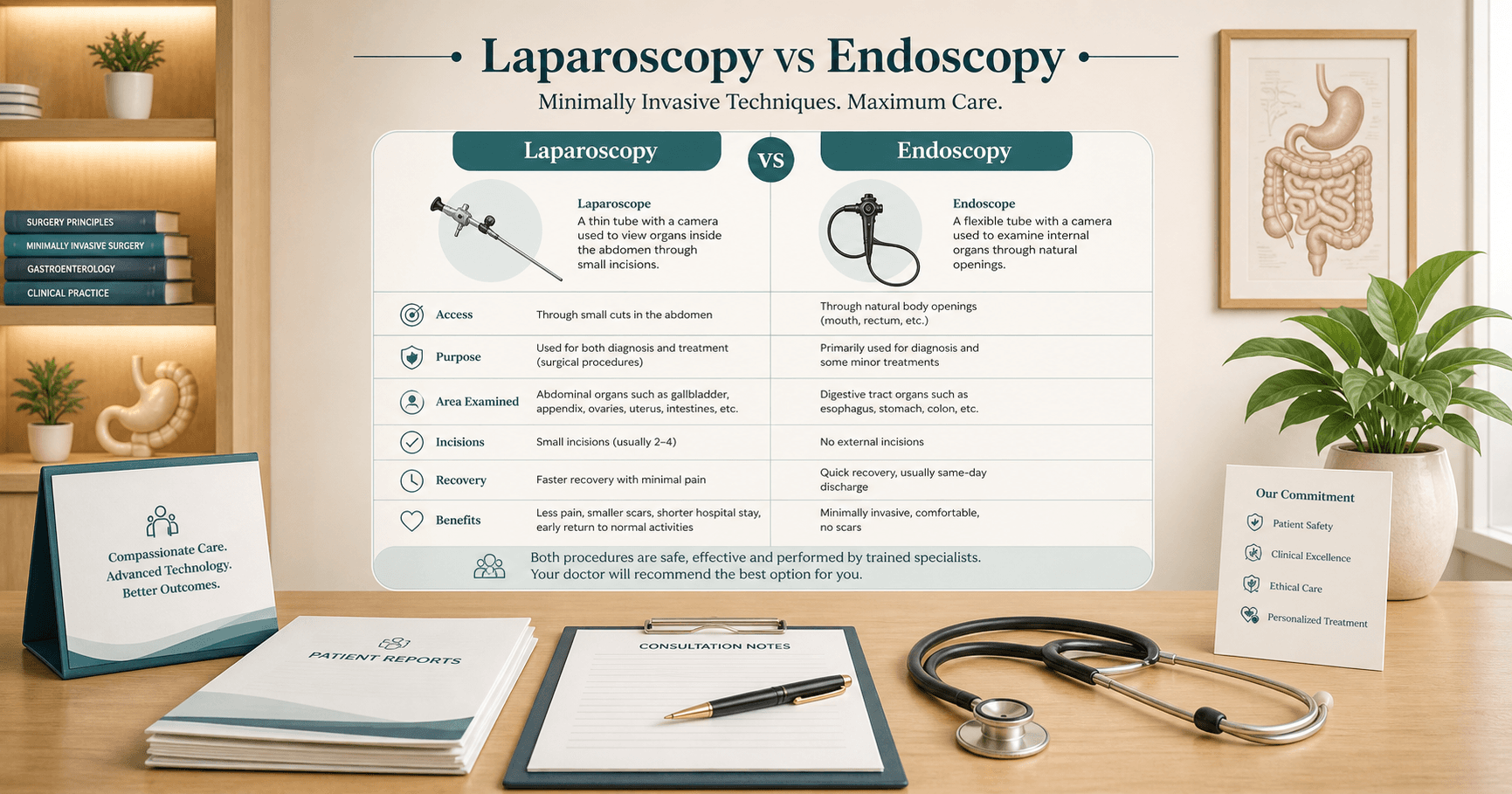
What is the difference between laparoscopy and endoscopy?
Laparoscopy and endoscopy are different camera-based procedures. Endoscopy usually passes a flexible camera through a natural opening to look inside the digestive tract. Laparoscopy uses small cuts in the abdomen so a surgeon can inspect or treat abdominal problems with a camera and instruments.
Laparoscopy is keyhole surgery performed through small abdominal incisions using a camera and specialized instruments. Endoscopy is a procedure that uses a thin camera tube to view internal organs or passages, often through the mouth or anus, and may be diagnostic or therapeutic depending on the case.
Fast decision rule: if the question is inside the stomach, food pipe or colon, endoscopy may be discussed. If the question is gallbladder stones, appendix, hernia, abdominal wall swelling or a surgical abdominal problem, a laparoscopic surgeon review is usually more relevant.
When is laparoscopy usually discussed?
Laparoscopy is usually discussed when the problem may need surgical evaluation inside the abdomen or abdominal wall. Examples include selected gallbladder stone surgery, appendix surgery, hernia repair, diagnostic abdominal inspection and some advanced laparoscopic procedures.
MedlinePlus explains that laparoscopy is done through a small cut using a laparoscope and may help diagnose or treat abdominal and pelvic conditions: https://medlineplus.gov/ency/article/002916.htm. Mayo Clinic describes minimally invasive surgery as using smaller surgical cuts than open surgery, while still carrying surgical risks: https://www.mayoclinic.org/tests-procedures/minimally-invasive-surgery/about/pac-20384771.
For Bhopal patients, the practical question is not "Do I need laparoscopy today?" It is "Do my symptoms and reports need a surgeon to decide between observation, medicines, laparoscopic surgery, open surgery or emergency care?"
When is endoscopy usually discussed?
Endoscopy is usually discussed when a doctor needs to look inside the digestive tract, such as the food pipe, stomach, upper small intestine, colon or rectum. It may be used to investigate swallowing problems, bleeding, ulcers, persistent upper digestive symptoms or bowel-related concerns depending on the specialist assessment.
NIDDK explains that upper GI endoscopy lets doctors see the lining of the upper digestive tract using an endoscope: https://www.niddk.nih.gov/health-information/diagnostic-tests/upper-gi-endoscopy. NIDDK colonoscopy guidance explains that colonoscopy lets doctors examine the rectum and colon using a colonoscope: https://www.niddk.nih.gov/health-information/diagnostic-tests/colonoscopy.
Endoscopy is not a replacement for surgical review when there is a painful hernia bulge, suspected appendix problem, gallbladder stone complication, severe abdominal pain or a surgical finding on ultrasound or CT. The correct specialist route depends on the complaint and reports.
Which symptoms need a laparoscopic surgeon instead of only an endoscopy plan?
A laparoscopic surgeon review is more relevant when symptoms suggest a surgical abdominal condition: right upper abdominal pain with gallstones, right lower abdominal pain with appendix concern, groin or navel swelling, recurrent hernia symptoms, painful abdominal wall bulge or worsening abdominal pain with vomiting or fever.
Comparison checklist: gallstones on ultrasound usually need surgeon review; a reducible hernia swelling needs surgeon review; suspected appendicitis needs urgent surgical assessment; food pipe or stomach lining concerns may need endoscopy discussion; bleeding in stool may need examination first because piles, fissure, fistula, colon and other causes are possible.
Do not self-select a procedure from symptoms alone. Two patients can describe "stomach pain" but need completely different paths: acidity evaluation, gallbladder review, appendix testing, hernia examination, colon evaluation or emergency care.
What reports should Bhopal patients carry before asking laparoscopy or endoscopy?
Carry every report that explains the symptom: ultrasound, CT, blood tests, urine tests, stool tests, previous endoscopy or colonoscopy reports, discharge summaries, operation notes, current medicines, allergy details and records for diabetes, blood pressure, heart, lung or kidney disease.
If ultrasound shows gallstones, use /articles/gallbladder-ultrasound-report-stones-bhopal to organize the questions before a surgeon visit. If the concern is appendix pain, /articles/appendicitis-test-ultrasound-blood-test-bhopal explains why blood tests and imaging are often reviewed together.
For laparoscopic surgery planning, /articles/questions-to-ask-before-laparoscopic-surgery-bhopal gives a focused checklist for diagnosis, anesthesia, medicines, fasting, recovery and warning signs. The more complete the reports, the less likely the consultation becomes guesswork.
Can endoscopy and laparoscopy both be needed?
Sometimes both can be part of a patient journey, but not automatically and not always on the same day. A patient may need endoscopy to evaluate digestive tract symptoms and later need surgeon review if reports, examination or symptoms point to a surgical abdominal condition.
The order depends on urgency, examination, imaging, bleeding risk, anesthesia fitness and the working diagnosis. A stable outpatient with long-running acidity-like symptoms is different from a patient with fever, jaundice, repeated vomiting, severe pain or a stuck painful hernia bulge.
The safest approach is diagnosis-first review. Ask the doctor which question each procedure is meant to answer, what result would change the plan, and which symptoms mean you should not wait for a scheduled appointment.
Which warning signs should not wait for an appointment?
Seek urgent medical care for severe or worsening abdominal pain, repeated vomiting, fever, yellow eyes, black stool, heavy bleeding, fainting, chest pain, breathing difficulty, confusion, dehydration signs, or a painful hernia swelling that is stuck and not going back in.
NHS laparoscopy guidance notes that recovery and risks vary by procedure, and serious symptoms need medical review: https://www.nhs.uk/tests-and-treatments/laparoscopy/. MedlinePlus after-surgery guidance also stresses that patients should know warning signs after procedures: https://medlineplus.gov/aftersurgery.html.
This article is patient education, not diagnosis, prescription advice, emergency triage or a substitute for examination. If symptoms are severe, sudden, worsening or the patient looks very unwell, call the treating hospital or go to emergency care first.
How do you choose the next step in Bhopal?
Choose the next step by matching the symptom to the medical question. Digestive tract lining questions may need physician or gastroenterology-led endoscopy discussion. Gallbladder, appendix, hernia, abdominal wall swelling and surgical abdominal pain questions usually need a surgeon review first.
Dr. Rajesh Kanungo evaluates general and laparoscopic surgery concerns at R.K. Hospital, Indrapuri, Bhopal, including gallbladder stones, hernia, appendix symptoms, piles, fissure, fistula and selected advanced laparoscopic procedures. Bring previous reports so the discussion can focus on your actual condition rather than a generic procedure name.
The cleanest consultation outcome is a written next step: observe, test further, consult another specialist, plan endoscopy, plan laparoscopic surgery, consider open surgery, or go to emergency care. If that next step is unclear, ask again before leaving.
Which medical sources support this guide?
This guide was cross-checked against MedlinePlus laparoscopy information at https://medlineplus.gov/ency/article/002916.htm, Mayo Clinic minimally invasive surgery information at https://www.mayoclinic.org/tests-procedures/minimally-invasive-surgery/about/pac-20384771, NIDDK upper GI endoscopy guidance at https://www.niddk.nih.gov/health-information/diagnostic-tests/upper-gi-endoscopy, NIDDK colonoscopy guidance at https://www.niddk.nih.gov/health-information/diagnostic-tests/colonoscopy, NHS laparoscopy guidance at https://www.nhs.uk/tests-and-treatments/laparoscopy/, and MedlinePlus after-surgery guidance at https://medlineplus.gov/aftersurgery.html.
These sources support the same patient-safety message: camera-based procedures answer different questions, risks vary by procedure and patient, and severe or worsening symptoms should be reviewed urgently rather than managed through online comparison alone.
Related care options
More patient guides
Fissure Inside the Anus: What the Pain Pattern Can Mean
A fissure is a small tear in the lining at the anal opening. Sharp pain during a bowel movement, burning that continues afterward and a small amount of bright red blood can fit this pattern, but symptoms alone cannot confirm the cause. Repeated pain or bleeding deserves examination; fever, swelling, pus, heavy bleeding, black stool, fainting or severe worsening pain needs urgent medical care.
Appendicitis Pain Location: Where Does Appendix Pain Usually Start?
Appendicitis pain often begins near the navel and then moves toward the lower right abdomen, but the location can vary. Severe or worsening pain, especially with fever, repeated vomiting, marked tenderness, faintness or a very unwell feeling, needs urgent medical assessment rather than a home diagnosis.
Types of Abdominal Hernias: A Location Guide for Bhopal Patients
Abdominal hernias are named mainly by where tissue pushes through a weak area: the groin, upper thigh, navel, upper midline, abdominal wall or an old surgical scar. Location is a useful clue, but examination—not a photo or symptom list—is what separates a hernia from other lumps and guides safe treatment.
Common questions
No. Both use cameras, but laparoscopy is keyhole surgery through small abdominal cuts, while endoscopy usually passes a flexible camera through a natural opening to view the digestive tract.
Neither is universally better. They answer different questions. The right choice depends on symptoms, examination, reports, urgency, anesthesia fitness and whether the problem is surgical or inside the digestive tract lining.
Standard digestive endoscopy is not the usual test for gallbladder stones or appendicitis. Doctors commonly review symptoms, examination, blood tests and imaging such as ultrasound or CT depending on the case.
Consult a laparoscopic surgeon for gallbladder stones, hernia swelling, suspected appendix symptoms, surgical abdominal pain, abdominal wall swelling, or when ultrasound or CT suggests a condition that may need surgical review.
Seek urgent care for severe or worsening pain, repeated vomiting, fever, jaundice, black stool, heavy bleeding, fainting, chest pain, breathing difficulty, confusion, dehydration signs or a stuck painful hernia swelling.