
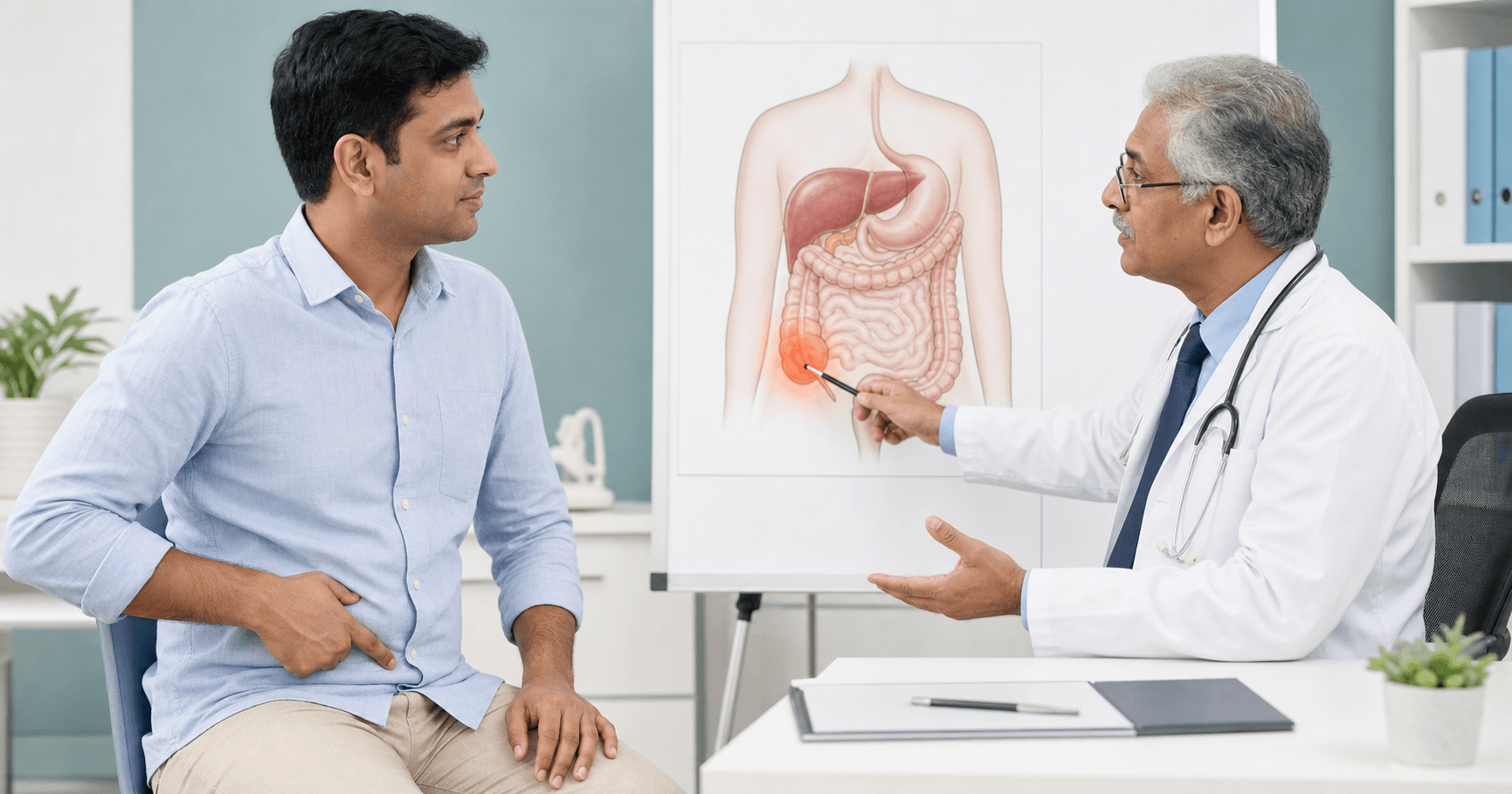
Can right lower abdomen pain when walking be appendicitis?
Yes, right lower abdomen pain that worsens while walking, coughing, climbing stairs or changing position can happen with appendicitis because movement may irritate the inflamed area. It can also happen with gas, urinary problems, bowel infection, muscle strain, hernia, pelvic causes or other abdominal conditions, so symptoms alone cannot confirm the cause.
Appendicitis is inflammation of the appendix, a small pouch attached to the large intestine. The useful patient question is not “Can I diagnose this myself?” It is “Is the pain trend getting worse or becoming more localized?”
Fast decision rule: mild discomfort that clearly improves can be watched carefully. Pain that settles in the right lower abdomen, worsens with movement, or comes with fever, vomiting, appetite loss, faintness or marked tenderness should be assessed urgently.
Why can appendicitis pain worsen with walking or coughing?
Appendicitis pain may worsen with walking or coughing when inflammation irritates the lining inside the abdomen. Movement, jarring steps, coughing or pressing the belly can make that irritated area hurt more. This pattern is a warning clue, not proof of appendicitis.
Mayo Clinic describes appendicitis pain as often beginning near the navel and moving to the lower right abdomen, and notes that coughing, walking or jarring movement may worsen the pain. MedlinePlus and NIDDK also describe appendicitis as a condition that needs prompt medical evaluation because complications can occur.
The practical takeaway: do not keep testing the pain by repeatedly jumping, pressing the abdomen or walking to “check” appendicitis. If normal movement is making pain sharper or more focused, call a doctor or use emergency care depending on severity.
Which warning signs make right lower abdominal pain urgent?
Right lower abdominal pain needs urgent medical review when it is severe, worsening, persistent, more painful with walking or coughing, or appears with fever, repeated vomiting, appetite loss, abdominal swelling, fainting, pregnancy possibility, marked tenderness, confusion or a very unwell patient.
Emergency guidance: go to emergency care or call the hospital if pain is severe or spreading, the abdomen is hard or swollen, vomiting is repeated, fever is high, the patient faints, there is confusion, black stool, heavy bleeding, or the patient appears very unwell.
Do not wait for every classic symptom. Early appendicitis may not look textbook, and older adults, children, pregnant patients and people with diabetes can have less typical symptoms. A worsening trend matters more than a perfect symptom list.
How can patients compare movement pain, gas pain and muscle pain?
A simple comparison is trend, location and associated symptoms. Gas pain often feels crampy, bloated or moving, and may improve after passing gas or stool. Muscle pain is often linked to strain, posture or a tender surface area. Appendix-related pain more often worsens, localizes and appears with nausea, fever, appetite loss or movement-related pain.
Decision table: improving mild bloating means careful observation may be reasonable; pain focused in the lower right abdomen means call a doctor; pain that worsens with walking, coughing or touch means urgent review is safer; severe pain with fever, repeated vomiting, fainting, swelling or pregnancy possibility means emergency care first.
Passing gas, taking an antacid or getting temporary relief after pain medicine does not safely rule out appendicitis. If the pain returns, localizes to the right lower abdomen, or becomes worse with movement, reassessment is the safer path.
What should you note before calling an appendix surgeon in Bhopal?
Write down when the pain started, where it began, where it hurts now, whether it moved from the belly button area, whether walking or coughing worsens it, whether fever or vomiting is present, whether appetite dropped, and whether there are urinary, bowel, menstrual, pregnancy-related or previous surgery details.
Carry ultrasound, CT, blood test, urine test and previous prescription reports if already done. Also carry allergy history, diabetes or BP medicine details, blood thinner information, past surgery papers and a written list of pain, acidity or fever medicines already taken.
For stable patients in Bhopal, Dr. Rajesh Kanungo can review right lower abdominal pain, suspected appendix symptoms, reports and laparoscopic appendix surgery questions at R.K. Hospital, Indrapuri. Severe symptoms should go to emergency care first, not wait for a routine appointment.
How do doctors check whether appendicitis is possible?
Doctors check possible appendicitis with symptom history, abdominal examination, temperature, pulse, blood tests, urine tests, pregnancy testing when relevant, ultrasound, CT scan or observation. The exact plan depends on age, pain severity, pregnancy possibility, examination findings and clinical judgment.
MedlinePlus appendicitis testing guidance describes physical examination, blood tests, urine tests and imaging as possible parts of evaluation. ACOG advises urgent evaluation for severe abdominal or pelvic pain during pregnancy because some causes need immediate care.
If your main concern is whether the pain feels like gas, read /articles/appendix-pain-vs-gas-pain-bhopal. If the pain began after lifting or exercise, /articles/appendix-pain-vs-muscle-strain-bhopal compares abdominal-wall strain with concerning appendix patterns. If reports are already done, /articles/appendicitis-test-ultrasound-blood-test-bhopal explains common appendix tests. For a child with abdominal pain, /articles/appendicitis-symptoms-children-bhopal gives parents age-aware warning signs.
When is appendix surgery discussed?
Appendix surgery is discussed when appendicitis is confirmed or strongly suspected and the treating team considers surgery the safer plan after assessment. Many patients are evaluated for laparoscopic appendectomy, but the final approach depends on infection severity, anatomy, reports, anesthesia fitness and surgeon judgment.
Appendectomy is surgery to remove the appendix. MedlinePlus notes that treatment for appendicitis often involves appendectomy, while some situations, such as abscess, rupture, pregnancy, another diagnosis or higher surgical risk, may change the plan.
The goal of this article is not to decide surgery from a search result. The goal is to recognize when movement-related right lower abdominal pain deserves urgent evaluation, prepare useful symptom notes, and discuss whether observation, tests, admission or surgery is appropriate.
Which medical sources support this guidance?
This article is patient education, not a diagnosis, prescription, emergency triage tool or replacement for examination. It was cross-checked against MedlinePlus appendicitis guidance at https://medlineplus.gov/appendicitis.html, MedlinePlus appendicitis testing guidance at https://medlineplus.gov/lab-tests/appendicitis-tests/, Mayo Clinic appendicitis guidance at https://www.mayoclinic.org/diseases-conditions/appendicitis/symptoms-causes/syc-20369543, NIDDK appendicitis guidance at https://www.niddk.nih.gov/health-information/digestive-diseases/appendicitis, NHS appendicitis guidance at https://www.nhsinform.scot/illnesses-and-conditions/stomach-liver-and-gastrointestinal-tract/appendicitis/, and ACOG pregnancy warning-sign guidance at https://www.acog.org/womens-health/faqs/bleeding-during-pregnancy.
These sources support the same conservative message: appendicitis can become urgent, pain patterns can overlap, and severe or worsening abdominal pain should be checked promptly rather than managed through online self-diagnosis.
Related care options
More patient guides
Fissure Inside the Anus: What the Pain Pattern Can Mean
A fissure is a small tear in the lining at the anal opening. Sharp pain during a bowel movement, burning that continues afterward and a small amount of bright red blood can fit this pattern, but symptoms alone cannot confirm the cause. Repeated pain or bleeding deserves examination; fever, swelling, pus, heavy bleeding, black stool, fainting or severe worsening pain needs urgent medical care.
Appendicitis Pain Location: Where Does Appendix Pain Usually Start?
Appendicitis pain often begins near the navel and then moves toward the lower right abdomen, but the location can vary. Severe or worsening pain, especially with fever, repeated vomiting, marked tenderness, faintness or a very unwell feeling, needs urgent medical assessment rather than a home diagnosis.
Types of Abdominal Hernias: A Location Guide for Bhopal Patients
Abdominal hernias are named mainly by where tissue pushes through a weak area: the groin, upper thigh, navel, upper midline, abdominal wall or an old surgical scar. Location is a useful clue, but examination—not a photo or symptom list—is what separates a hernia from other lumps and guides safe treatment.
Common questions
It can. Appendicitis pain may worsen with walking, coughing or jarring movement, especially when the pain is becoming focused in the right lower abdomen. This is not a diagnosis by itself, but it should be checked promptly if symptoms are worsening.
Yes. Gas can cause right-sided abdominal discomfort, bloating or cramping. The safer concern is pain that localizes, worsens over hours, comes with fever or vomiting, or becomes sharper with walking, coughing or touch.
No. Repeated pressing or jumping is not a safe home test. If normal movement or gentle touch makes right lower abdominal pain worse, contact a doctor or use emergency care depending on severity.
A general and laparoscopic surgeon can evaluate suspected appendix pain, review reports and discuss whether observation, tests, admission or appendix surgery is appropriate. Severe symptoms should go to emergency care first.