
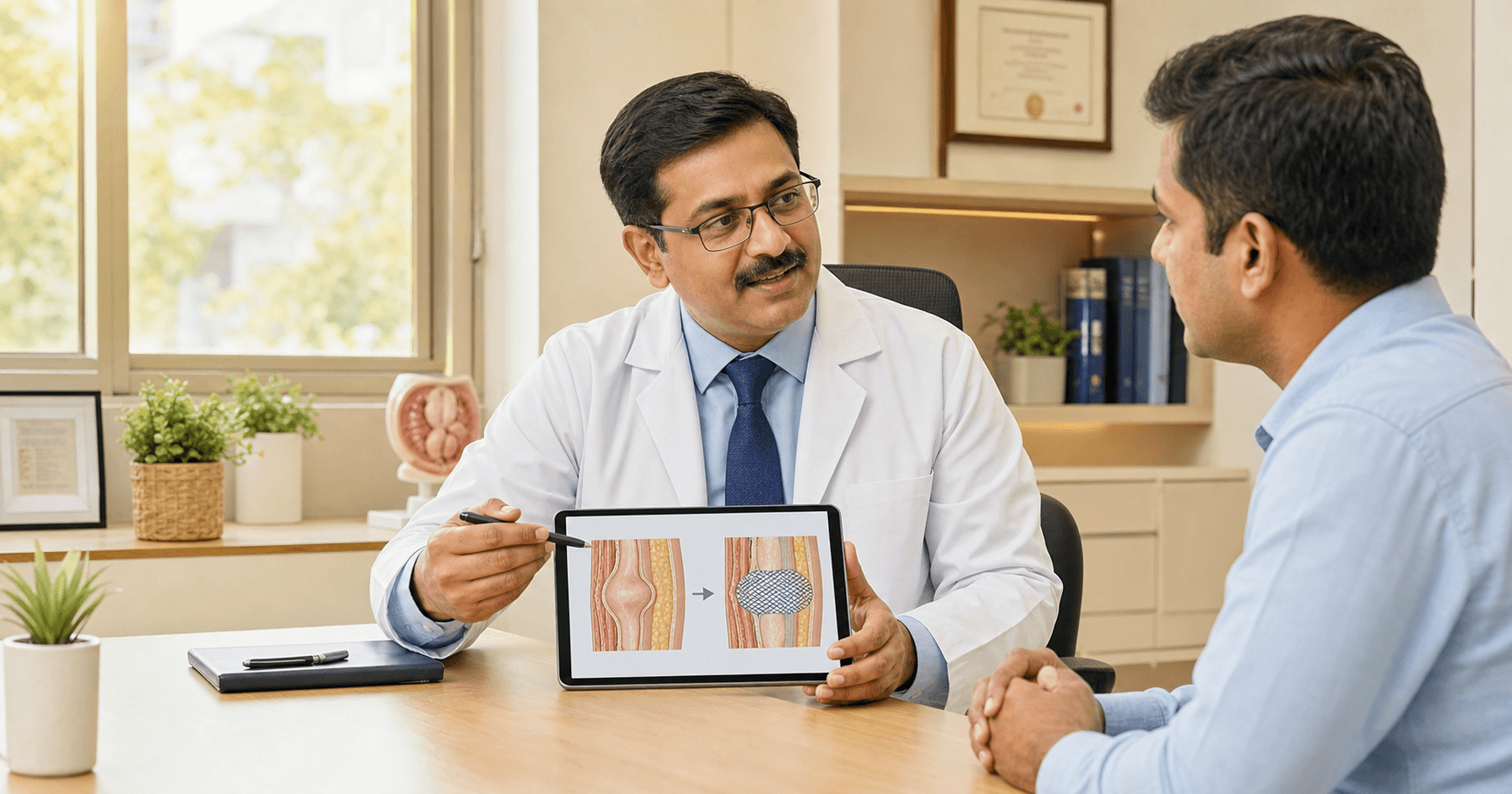
What is hernia mesh repair?
Hernia mesh repair is a surgical repair where a medical mesh is used to reinforce a weak area of the abdominal wall after the hernia defect is managed. It is commonly discussed for inguinal, umbilical, incisional and ventral hernias, but it is not chosen from the word "hernia" alone.
A hernia is a bulge caused by tissue pushing through a weak spot in the muscle or abdominal wall. Mesh is used in many repairs to add support and reduce strain on the repaired area, but the surgeon must match the plan to the patient, the hernia and the risk profile.
Fast decision rule: do not ask only "Is mesh good or bad?" Ask "Why is mesh suitable or not suitable for my hernia, and what would change that plan during surgery?" That question gets you closer to a useful answer.
Why do surgeons discuss mesh for hernia repair?
Surgeons discuss mesh because many adult hernias behave like a mechanical weakness, not just a pain problem. Reinforcement may reduce tension on the repair and can lower the chance of the hernia coming back in selected cases.
The U.S. FDA patient information says surgeons often use surgical mesh to strengthen hernia repair and reduce recurrence risk: https://www.fda.gov/medical-devices/implants-and-prosthetics/surgical-mesh-used-hernia-repair. SAGES patient information also explains that inguinal hernia repair can be open, laparoscopic or robotic and commonly involves mesh: https://www.sages.org/publications/patient-information/inguinal-hernia-repair-surgery-sages-patient-information/.
This does not mean every patient should demand mesh or refuse it. The practical discussion is case-specific: hernia size, one side or both sides, first repair or recurrent repair, previous abdominal surgery, obesity, diabetes, smoking, cough, constipation, infection risk and work demands all matter.
Is mesh used in open and laparoscopic hernia surgery?
Mesh can be used in both open and laparoscopic hernia repair, depending on the hernia and the chosen technique. In open repair, the surgeon works through an incision over the area. In laparoscopic repair, the repair is done through small cuts with camera guidance when suitable.
NHS patient guidance describes open and keyhole approaches for inguinal hernia repair and notes that the best approach depends on factors such as the patient, the hernia and recovery considerations: https://www.nhs.uk/tests-and-treatments/inguinal-hernia-repair/. Mayo Clinic also explains that inguinal hernia diagnosis and treatment decisions start with examination and sometimes imaging: https://www.mayoclinic.org/diseases-conditions/inguinal-hernia/diagnosis-treatment/drc-20351553.
Simple comparison: open repair may be preferred for some large, complex, high-risk or previous-surgery situations; laparoscopic repair may be discussed for selected inguinal, bilateral or recurrent situations; emergency or infected cases may need a different plan. Your surgeon should explain the reason in plain language. For a fuller decision guide, read /articles/open-vs-laparoscopic-hernia-surgery-bhopal.
What should patients ask before hernioplasty with mesh repair?
Before hernioplasty with mesh repair, ask what type of hernia you have, whether the bulge is reducible, whether imaging is needed, why mesh is being considered, what material or mesh type is planned, and whether open or laparoscopic repair is safer for your case.
Use this checklist in the consultation: What is my hernia type? Is it inguinal, umbilical, epigastric, incisional or ventral? Is it first-time or recurrent? Is mesh likely? Where will it be placed? What are the common risks? What warning signs should bring me to emergency care before the planned date? When can I walk, climb stairs, return to work and lift weight?
Patients who already have a report can also read /articles/direct-vs-indirect-inguinal-hernia-bhopal for groin hernia wording, /articles/umbilical-hernia-symptoms-adults-bhopal for navel swelling, /articles/above-belly-button-hernia-bhopal for epigastric or upper-midline swelling, /articles/recurrent-hernia-after-surgery-bhopal for a returning bulge after previous repair, and /articles/questions-to-ask-before-laparoscopic-surgery-bhopal for a wider surgery checklist.
When should hernia symptoms be treated as urgent?
Urgent care is safer when a hernia bulge becomes painful and stuck, suddenly worse, red, purple, dark, hot, tender, or comes with vomiting, fever, abdominal swelling, constipation, inability to pass gas, fainting, confusion or a very unwell patient.
NIDDK warns that inguinal hernias can become incarcerated or strangulated and need immediate medical care when symptoms such as sudden pain, fever, nausea, vomiting, color change or inability to pass gas or stool appear: https://www.niddk.nih.gov/health-information/digestive-diseases/inguinal-hernia. Mayo Clinic lists similar emergency signs for inguinal hernia, including nausea, vomiting, fever and red, purple or dark color change: https://www.mayoclinic.org/diseases-conditions/inguinal-hernia/symptoms-causes/syc-20351547.
Do not wait for a routine price quote, online answer or planned OPD slot if these signs appear. Call the treating hospital, go to emergency care or use local emergency services. For a focused red-flag page, read /articles/strangulated-hernia-symptoms-bhopal.
What can affect recovery after mesh hernia surgery?
Recovery after mesh hernia surgery depends on the hernia type, repair route, pain control, wound healing, infection risk, constipation, cough, work demands, lifting needs, diabetes control, smoking status, body weight and whether the surgery was planned or urgent.
NHS inguinal hernia repair guidance tells patients to follow the hospital's instructions on wound care, activity and when to get help after surgery: https://www.nhs.uk/tests-and-treatments/inguinal-hernia-repair/. FDA patient information also emphasizes talking with the surgeon about mesh benefits and risks for the individual case: https://www.fda.gov/medical-devices/implants-and-prosthetics/surgical-mesh-used-hernia-repair.
Low-effort preparation: write down your job duties, daily lifting, commute, stairs at home, diabetes or BP medicines, blood thinner use and previous surgery details. That turns a vague "How many days rest?" question into a practical recovery plan. For a deeper recovery guide, read /articles/hernia-surgery-recovery-time-bhopal.
How should Bhopal patients decide the next step?
The next step is diagnosis-first consultation, not a mesh-first decision. A surgeon should examine the swelling, review ultrasound or CT reports if needed, check reducibility and warning signs, then explain observation, open repair, laparoscopic repair, mesh discussion and recovery expectations.
Decision table: soft reducible swelling with mild symptoms means planned surgeon review; painful or growing swelling means earlier consultation; recurrent hernia or previous mesh repair means bring old records; painful stuck swelling with vomiting, fever, color change, bloating or constipation means emergency care first.
For Bhopal patients, Dr. Rajesh Kanungo evaluates inguinal, umbilical, incisional and abdominal wall hernias at R.K. Hospital, Indrapuri. Bring your reports, medicine list, previous surgery papers and work-lifting details so the consultation can answer your actual repair and recovery question.
Which medical sources support this guide?
This article is patient education, not a diagnosis, prescription, surgical quote, device recommendation or replacement for examination. It was cross-checked against FDA surgical mesh patient information at https://www.fda.gov/medical-devices/implants-and-prosthetics/surgical-mesh-used-hernia-repair, NIDDK inguinal hernia guidance at https://www.niddk.nih.gov/health-information/digestive-diseases/inguinal-hernia, Mayo Clinic inguinal hernia symptoms and treatment guidance at https://www.mayoclinic.org/diseases-conditions/inguinal-hernia/symptoms-causes/syc-20351547 and https://www.mayoclinic.org/diseases-conditions/inguinal-hernia/diagnosis-treatment/drc-20351553, NHS inguinal hernia repair guidance at https://www.nhs.uk/tests-and-treatments/inguinal-hernia-repair/, and SAGES patient information at https://www.sages.org/publications/patient-information/inguinal-hernia-repair-surgery-sages-patient-information/.
These sources support the same conservative message: mesh is commonly discussed for selected hernia repairs, but the safest decision depends on examination, hernia type, urgency, patient health and surgeon judgment. Severe pain, vomiting, fever, color change or a stuck bulge should not be managed by online reading.
Related care options
More patient guides
Fissure Inside the Anus: What the Pain Pattern Can Mean
A fissure is a small tear in the lining at the anal opening. Sharp pain during a bowel movement, burning that continues afterward and a small amount of bright red blood can fit this pattern, but symptoms alone cannot confirm the cause. Repeated pain or bleeding deserves examination; fever, swelling, pus, heavy bleeding, black stool, fainting or severe worsening pain needs urgent medical care.
Appendicitis Pain Location: Where Does Appendix Pain Usually Start?
Appendicitis pain often begins near the navel and then moves toward the lower right abdomen, but the location can vary. Severe or worsening pain, especially with fever, repeated vomiting, marked tenderness, faintness or a very unwell feeling, needs urgent medical assessment rather than a home diagnosis.
Types of Abdominal Hernias: A Location Guide for Bhopal Patients
Abdominal hernias are named mainly by where tissue pushes through a weak area: the groin, upper thigh, navel, upper midline, abdominal wall or an old surgical scar. Location is a useful clue, but examination—not a photo or symptom list—is what separates a hernia from other lumps and guides safe treatment.
Common questions
Hernia mesh repair is commonly used for selected hernia repairs, but safety depends on the patient, hernia type, infection risk, technique and surgeon assessment. Ask why mesh is suitable for your case and what risks apply to you.
No. Mesh is common in many adult hernia repairs, but the decision depends on hernia type, size, tissue quality, infection risk, recurrence risk and whether open or laparoscopic repair is planned.
A hernia can recur even after repair, though mesh is often used to reduce recurrence risk in selected cases. Recovery instructions, cough, constipation, lifting, diabetes control, smoking and follow-up can also affect recurrence risk.
Seek urgent medical help if the hernia becomes painful and stuck, red, purple or dark, or if there is vomiting, fever, abdominal swelling, constipation, inability to pass gas, fainting or a very unwell patient.