
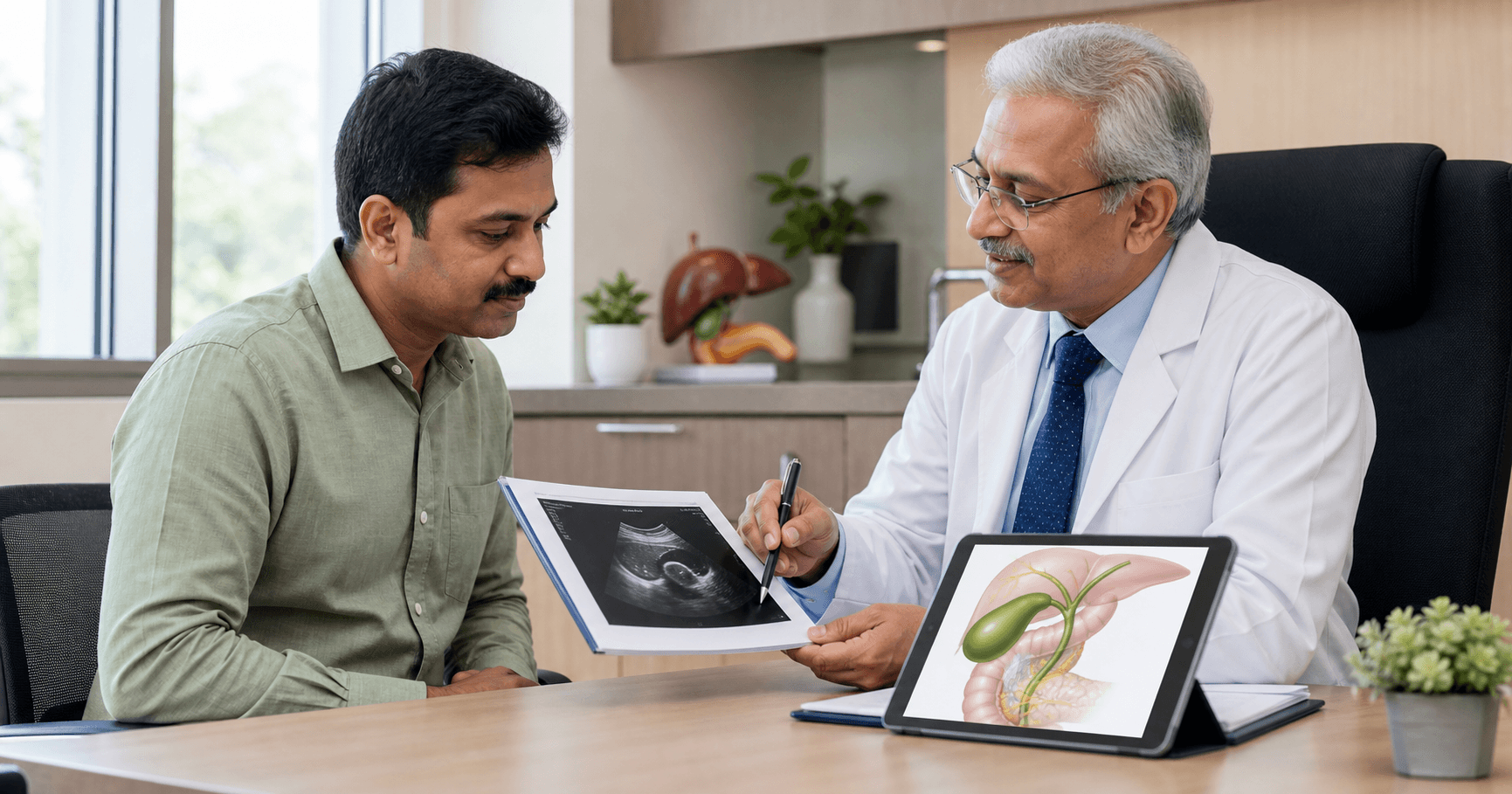
What size gallstone needs surgery?
There is no single gallstone size that automatically means surgery is required. A small stone can cause a bile-duct blockage or pancreatitis, while a larger stone may remain silent. Surgeons usually decide from symptoms, complications, stone location, scan findings, blood tests and the patient's overall fitness—not diameter alone.
Gallstone size is the diameter reported on ultrasound, usually in millimetres. It is one clue in a larger clinical picture; it is not a stand-alone diagnosis, risk score or operation rule.
Fast decision rule: do not ask only “How many millimetres is the stone?” Ask whether it is causing typical attacks, inflammation, jaundice, bile-duct obstruction or pancreatitis, and whether the report shows another feature needing review.
Why can a small gallstone still cause a serious problem?
A small gallstone may leave the gallbladder and enter a narrow bile duct. If it becomes stuck, bile can back up and the patient may develop jaundice, infection or pancreatitis. This is why “small” does not mean harmless and why pain plus warning signs matters more than size alone.
NIDDK explains that gallstones blocking bile ducts can cause a gallbladder attack and, if blockage persists, serious inflammation or infection of the gallbladder, liver or pancreas: https://www.niddk.nih.gov/health-information/digestive-diseases/gallstones/symptoms-causes.
Small stones are not automatically dangerous either. Many gallstones cause no symptoms. The safe interpretation comes from matching the ultrasound with pain pattern, examination and blood tests rather than treating a measurement as a prediction.
Does a large gallstone automatically mean an operation?
No. A large gallstone deserves clinical review, but size by itself does not prove that current symptoms come from the gallbladder or that an operation is urgent. A surgeon considers whether the stone is silent or symptomatic, whether complications are present, and whether another diagnosis better explains the pain.
NIDDK states that gallstones without symptoms probably do not need treatment, while a gallbladder attack or other symptoms should be assessed by a doctor: https://www.niddk.nih.gov/health-information/digestive-diseases/gallstones/treatment. NHS guidance similarly says gallbladder removal is often recommended when stones cause severe or frequent abdominal pain: https://www.nhs.uk/tests-and-treatments/gallbladder-removal/why-its-done/.
Do not use an online cut-off to book, delay or refuse surgery. Unusual ultrasound features, very large stones, gallbladder wall changes, polyps, bile-duct findings or individual cancer risk may change the discussion and need specialist interpretation.
What matters more than the stone measurement?
The strongest decision clues are repeated typical pain, fever, vomiting, jaundice, pancreatitis, gallbladder inflammation, bile-duct stones, abnormal liver tests and whether symptoms interfere with eating or daily life. Medical fitness and anesthesia risk also affect when and how an operation is planned.
Decision checklist: silent finding with no symptoms usually means planned review; repeated upper-right abdominal attacks need surgical discussion; fever or jaundice needs urgent assessment; a bile-duct stone may require an endoscopic or surgical plan; major heart, lung, diabetes or blood-thinner risks need coordinated preoperative review.
The guide to /articles/gallbladder-ultrasound-report-stones-bhopal explains report terms beyond size. If surgery is being discussed, /articles/gallbladder-surgery-tests-ultrasound-blood-mrcp-bhopal covers why ultrasound, blood tests or MRCP may be considered in selected patients.
When should gallstone symptoms go to emergency care?
Seek urgent medical care for severe or persistent abdominal pain, fever or chills, yellow skin or eyes, repeated vomiting, tea-coloured urine, pale stools, fainting, confusion, breathing difficulty, chest pain, dehydration or a patient who looks very unwell. Do not wait for a routine appointment when these signs are present.
NIDDK advises immediate medical attention for abdominal pain lasting several hours, nausea or vomiting, fever or chills, jaundice, tea-coloured urine or light-coloured stools: https://www.niddk.nih.gov/health-information/digestive-diseases/gallstones/symptoms-causes.
This page cannot diagnose the cause or severity of pain. Call the treating doctor, go to an emergency department or use local emergency services. For a focused timing checklist, see /articles/gallbladder-attack-duration-emergency-bhopal.
What should you carry to a gallstone consultation in Bhopal?
Carry the ultrasound report and images, liver function tests and CBC if available, previous admission notes, current medicine list, allergy history and details of diabetes, heart, lung or kidney conditions. Write down where pain starts, how long it lasts, food triggers, vomiting, fever, jaundice and previous attacks.
Ask five questions: Do my symptoms match gallstone disease? Does the scan show inflammation or bile-duct concern? Are more tests needed? Is observation or planned laparoscopic surgery safer? Which warning signs should send me to hospital immediately?
Dr. Rajesh Kanungo reviews gallstone symptoms and reports at R.K. Hospital, Indrapuri, Bhopal. Use /services/gallbladder-stone-surgery for service details and /contact for a non-emergency appointment. If surgery is already planned, /articles/gallbladder-stone-surgery-preparation-bhopal provides a practical admission checklist.
Which medical sources support this guide?
This patient-education guide is not a diagnosis, prescription or personalized surgical recommendation. It was cross-checked against NIDDK guidance on gallstone symptoms and complications at https://www.niddk.nih.gov/health-information/digestive-diseases/gallstones/symptoms-causes, NIDDK treatment guidance at https://www.niddk.nih.gov/health-information/digestive-diseases/gallstones/treatment, and NHS guidance on why gallbladder removal is performed at https://www.nhs.uk/tests-and-treatments/gallbladder-removal/why-its-done/.
These sources support the practical conclusion: symptoms and complications drive treatment decisions, silent stones often do not need treatment, and severe pain, fever, jaundice or repeated vomiting requires prompt medical assessment.
Related care options
More patient guides
When Can I Shower After Laparoscopic Surgery?
Many patients can take a brief shower after laparoscopic surgery once their surgical team says the wound and dressing may get wet, but the correct timing depends on the operation, closure and dressing. Follow the discharge sheet rather than a universal 24- or 48-hour rule, and avoid soaking until specifically cleared.
What to Wear for Laparoscopic Surgery: Bhopal Patient Guide
For planned laparoscopic surgery, wear clean, loose, easy-to-remove clothes and slip-on footwear, and leave jewellery and valuables at home. The best discharge outfit avoids pressure on the abdomen and is simple for the patient or attendant to manage.
Anal Itching: Is It Piles or Another Cause?
Anal itching can happen with piles, but moisture, skin irritation, stool leakage, infection and other conditions can cause the same symptom. Keep the area gently clean and dry, avoid repeated medicated creams without advice, and arrange medical review if itching persists, recurs or comes with bleeding, pain, swelling or discharge.
Common questions
What size gallstone is considered large?
Reports may describe a stone as large relative to other stones, but there is no universal size that decides surgery for every patient. Symptoms, complications, stone location, gallbladder findings and medical fitness matter more than the label.
Can a 5 mm gallstone cause problems?
A small stone can cause problems if it moves into and blocks a bile duct, but many small stones never cause symptoms. A doctor should interpret the size together with pain, jaundice, fever, vomiting, ultrasound findings and blood tests.
Do asymptomatic gallstones need surgery?
Often they do not need immediate treatment, but the decision is individualized. A planned review is sensible if the report is unclear, unusual risk factors are present, or symptoms develop.
When is gallstone pain an emergency?
Seek urgent care for severe or persistent abdominal pain, fever or chills, jaundice, repeated vomiting, dark urine, pale stools, fainting, confusion, breathing difficulty or a very unwell patient.