
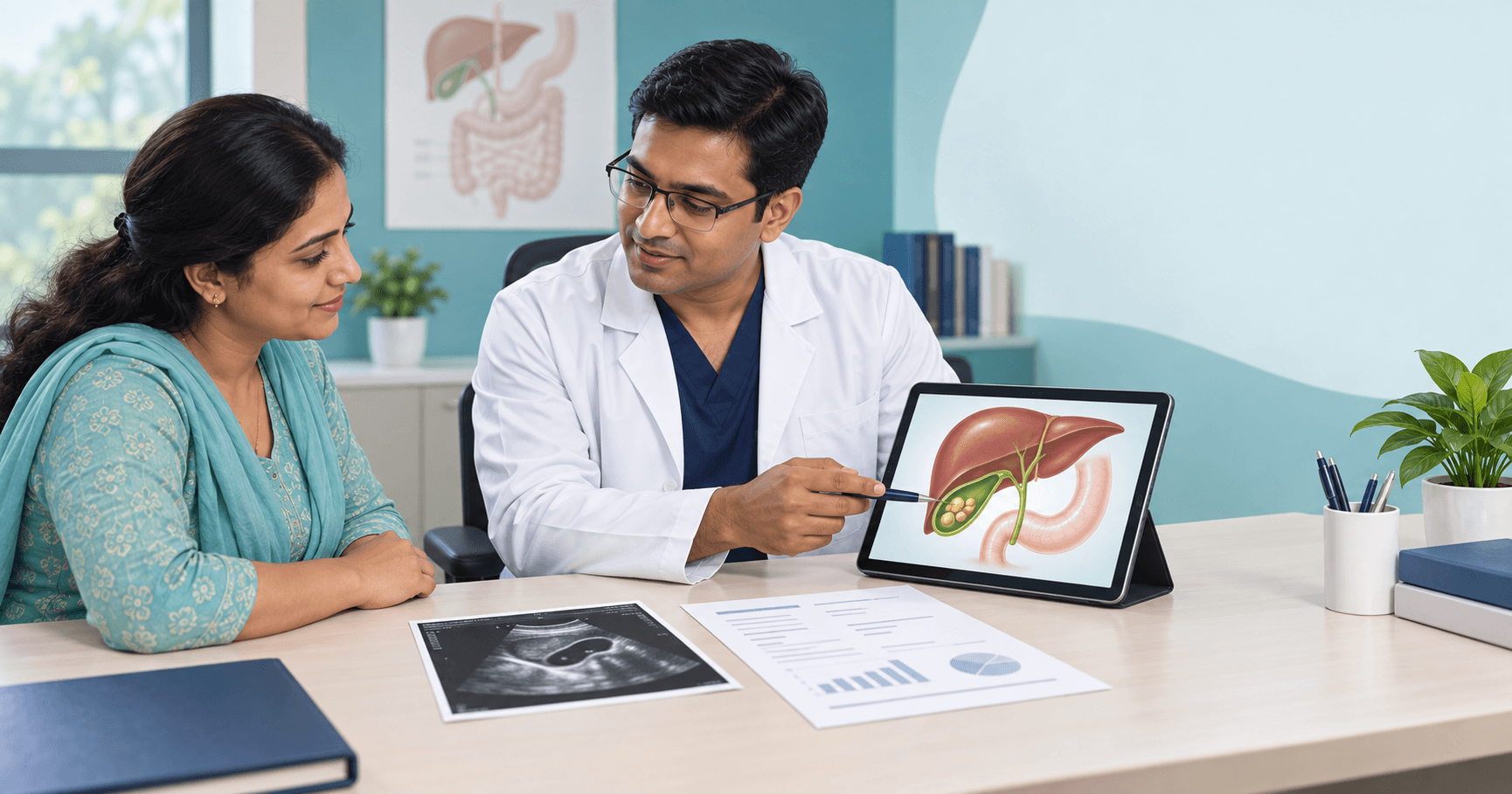
Which tests are commonly needed before gallbladder surgery?
Tests before gallbladder surgery commonly include an abdominal ultrasound, a complete blood count, liver function tests and basic pre-anaesthesia checks selected for the patient. Kidney function, blood sugar, clotting tests, ECG or chest assessment may be added according to age, medical history and the planned anaesthetic.
A pre-operative gallbladder test is a scan, laboratory test or fitness assessment used to confirm the problem, look for complications and plan surgery safely. Not every patient needs every test, and a normal-looking report does not replace examination by the surgical team.
Fast decision rule: ultrasound and blood tests are the usual starting point; MRCP is a question for selected patients when jaundice, abnormal liver tests, a widened bile duct or another finding raises concern about a bile-duct stone.
What does an ultrasound show before gallbladder removal?
Ultrasound can show gallstones, sludge, gallbladder wall thickening, fluid around the gallbladder and widening of the bile ducts. These findings help the surgeon compare the scan with the pain pattern, examination and blood results before recommending the next step.
NIDDK identifies ultrasound as the best imaging test for finding gallstones: https://www.niddk.nih.gov/health-information/digestive-diseases/gallstones/diagnosis. A useful consultation still asks more than whether stones are present: do the symptoms match, is there inflammation, and is there any sign that a stone may have moved into the common bile duct?
Bring the written report and the available images or digital link. The focused guide at /articles/gallbladder-ultrasound-report-stones-bhopal explains common report terms and the questions worth asking after a scan shows stones.
Which blood tests may be checked for gallstones?
Blood tests may look for infection or inflammation and for signs involving the liver, bile ducts or pancreas. A clinician may review CBC, bilirubin, liver enzymes and, when pancreatitis is a concern, pancreatic enzymes; the exact panel depends on symptoms and examination.
NIDDK notes that blood tests can show signs of infection or inflammation involving the bile ducts, gallbladder, pancreas or liver: https://www.niddk.nih.gov/health-information/digestive-diseases/gallstones/diagnosis. Results must be interpreted together because one abnormal value does not diagnose a blocked duct or decide an operation by itself.
Carry older reports as well as the latest set. A trend can help the treating team understand whether a result is new, improving or worsening, but only the clinician reviewing the full situation can decide whether repeat testing or urgent assessment is needed.
When might MRCP be considered before gallbladder surgery?
MRCP may be considered when the team suspects a stone in the common bile duct rather than only stones inside the gallbladder. Clues can include jaundice, abnormal liver tests, a widened bile duct on ultrasound, pancreatitis or a previous episode suggesting bile-duct blockage.
MRCP means magnetic resonance cholangiopancreatography. It is a non-invasive MRI technique that produces detailed images of the liver, gallbladder, bile ducts and pancreas. RadiologyInfo explains the examination and its use for stones and other biliary problems: https://www.radiologyinfo.org/en/info/mrcp.
MRCP is not an automatic test for every person with gallstones. A practical question is: what finding in my symptoms, ultrasound or blood tests would make MRCP useful, and how would the result change the treatment plan?
How do ultrasound, MRCP and ERCP differ?
Ultrasound is usually the first scan for gallstones. MRCP is a non-invasive MRI study that can map the bile ducts in more detail. ERCP is an endoscopic procedure that can diagnose and treat certain bile-duct blockages, but it is invasive and is not simply a routine substitute for ultrasound or MRCP.
Decision table: suspected stones limited to the gallbladder usually start with ultrasound; uncertain bile-duct anatomy or possible duct stone may lead to MRCP; a confirmed or strongly suspected duct blockage may require specialist discussion of ERCP or another treatment. The sequence depends on urgency and local clinical findings.
NIDDK explains that ERCP is used selectively and can remove a stone stuck in the common bile duct: https://www.niddk.nih.gov/health-information/digestive-diseases/gallstones/diagnosis. Ask who will coordinate the next step if a duct stone is suspected.
What fitness checks may be needed before anaesthesia?
Fitness checks are chosen according to the patient, not copied from a universal package. The team may review blood pressure, diabetes control, kidney function, haemoglobin, medicine use, allergies, previous anaesthesia problems, heart or lung history and an ECG when clinically appropriate.
Tell the team about prescription medicines, over-the-counter painkillers, blood thinners, supplements and herbal products. Do not stop aspirin, clopidogrel, warfarin, diabetes medicines or blood-pressure medicines because of an online article; follow the written plan from the treating and anaesthesia teams.
For a wider preparation checklist, see /articles/gallbladder-stone-surgery-preparation-bhopal and /articles/pre-anaesthesia-checkup-before-surgery-bhopal. The gallbladder stone surgery service page at /services/gallbladder-stone-surgery explains the consultation route in Bhopal.
When should symptoms go to emergency care instead of waiting for tests?
Do not wait for an outpatient test if upper abdominal pain is severe or persistent, or if it comes with fever, yellow eyes or skin, repeated vomiting, fainting, confusion, breathing difficulty, chest pain, inability to keep fluids down or a patient who looks very unwell.
NHS guidance lists sudden severe abdominal pain, jaundice and a high temperature with gallstone symptoms as reasons to seek urgent help: https://www.nhs.uk/conditions/gallstones/. NIDDK explains that untreated bile-duct or pancreatic-duct blockage can cause serious complications: https://www.niddk.nih.gov/health-information/digestive-diseases/gallstones/symptoms-causes.
Call the treating doctor, go to the nearest emergency department or use local emergency services. This article is general patient education, not diagnosis, prescription advice or a personal test order.
What should you carry to a gallbladder surgery consultation?
Carry the ultrasound report and images, all recent blood reports, prior hospital records, a medicine list with doses, allergy details and notes about each pain episode. Record where pain started, how long it lasted, whether it followed food, and whether fever, vomiting, jaundice, dark urine or pale stool occurred.
Consultation checklist: Which finding confirms the likely source of symptoms? Is a bile-duct stone suspected? Do I need repeat blood tests or MRCP? Is this planned or urgent? Am I suitable for laparoscopic surgery? Which medicines need a written plan? What warning signs should send me directly to hospital?
The easiest next step is to organise reports in date order and book a surgeon review rather than ordering every possible test yourself. That reduces duplicated testing and lets each result answer a specific clinical question.
Which medical sources support this guide?
This patient-education guide was cross-checked against NIDDK guidance on gallstone diagnosis at https://www.niddk.nih.gov/health-information/digestive-diseases/gallstones/diagnosis, NIDDK guidance on symptoms and complications at https://www.niddk.nih.gov/health-information/digestive-diseases/gallstones/symptoms-causes, NHS gallstones guidance at https://www.nhs.uk/conditions/gallstones/, and RadiologyInfo guidance on MRCP at https://www.radiologyinfo.org/en/info/mrcp.
The consistent message is conservative: ultrasound and selected blood tests commonly start the evaluation, MRCP is reserved for a clinical reason, invasive duct procedures are selective, and severe pain, fever, jaundice or repeated vomiting needs urgent medical assessment.
Related care options
More patient guides
Sleeping Position After Laparoscopic Surgery: A Safe Comfort Guide
There is no single sleeping position that is safest for every laparoscopic operation. Unless the surgical team gave a position restriction, use the position that lets you breathe comfortably and rest without pulling on wounds—often the back with support at first—then change position gradually as comfort allows.
Smoking Before Surgery: When Should You Stop?
Smoking before surgery can affect breathing, anaesthesia planning, wound healing and recovery. The useful next step is not to hide it or guess at a perfect quit date: tell the surgeon and anaesthesia team exactly what you use, how often, and when you last used it, then follow their written plan.
Piles Coming Out During Stool: When Does a Prolapse Need Review?
Tissue that comes out during a bowel movement may be prolapsed piles, but rectal prolapse and other anal conditions can look similar. Note whether it returns by itself, needs gentle pressure, stays outside, bleeds or becomes painful, then arrange an examination rather than trying to grade it at home.
Common questions
Is ultrasound enough before gallbladder surgery?
Ultrasound is usually the first scan, but the surgeon also reviews symptoms, examination, blood tests and anaesthesia fitness. Additional imaging may be considered if there is concern about a bile-duct stone or another complication.
Does everyone need MRCP before gallbladder removal?
No. MRCP is generally considered when symptoms, liver tests or ultrasound suggest a possible common bile-duct stone or unclear biliary anatomy. The treating team should explain what question the scan would answer.
Which blood tests are done before gallbladder surgery?
Tests may include CBC, liver function, bilirubin, kidney function and blood sugar, with pancreatic enzymes, clotting tests or other checks selected according to symptoms, medicines, age and medical history.
When are gallstone symptoms an emergency?
Seek urgent care for severe or persistent upper abdominal pain, fever, jaundice, repeated vomiting, fainting, confusion, breathing difficulty, chest pain, inability to keep fluids down or a very unwell patient.