
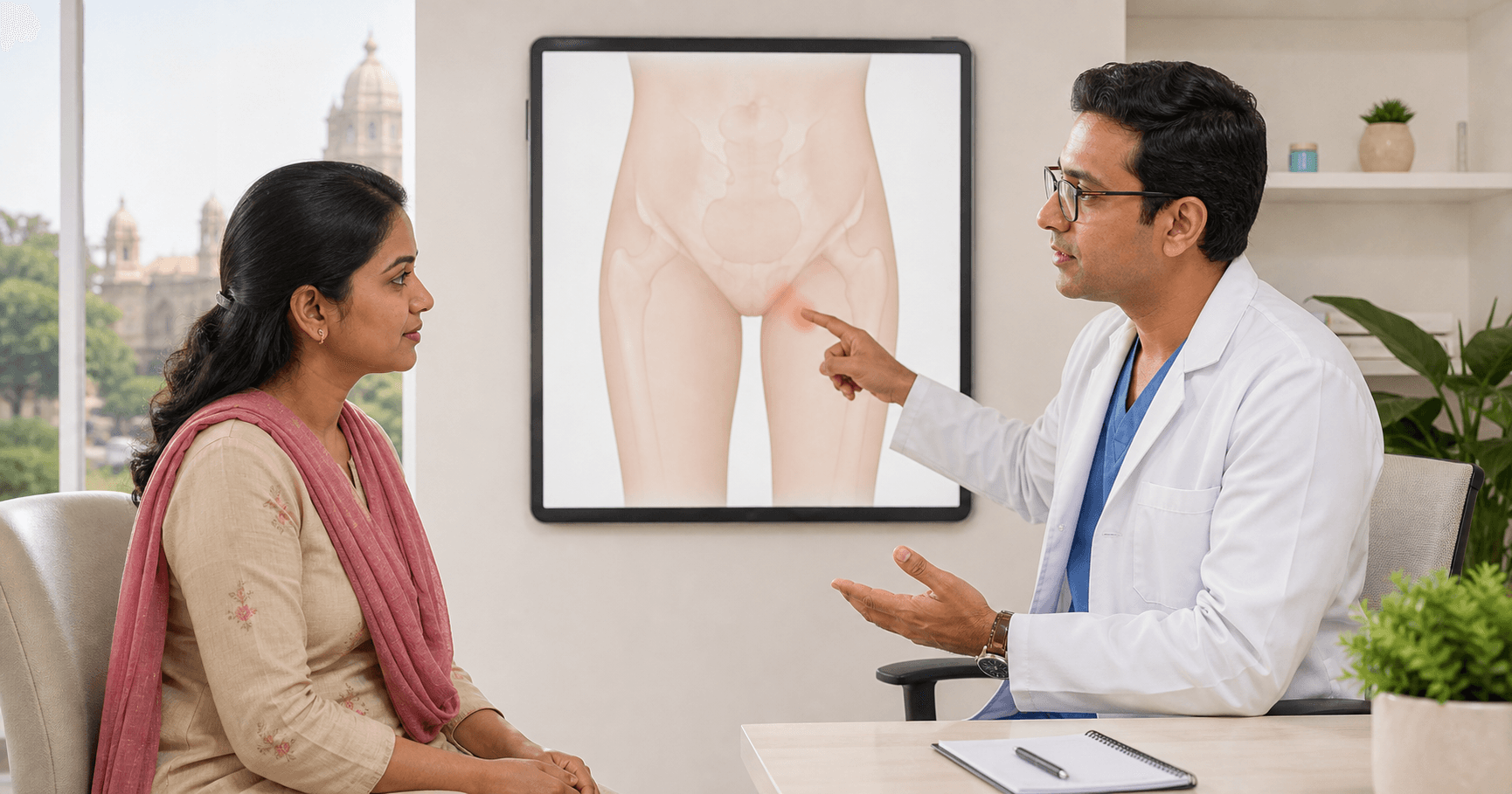
What are femoral hernia symptoms in women?
Femoral hernia symptoms in women may include a small lump, heaviness, pressure or pain at the upper inner thigh, just below the groin crease. Discomfort may become more noticeable while standing, coughing, lifting or straining, but some femoral hernias cause few symptoms until a complication develops.
A femoral hernia is tissue passing through a weak area into the femoral canal near the top of the thigh. It is different from an inguinal hernia, although patients may describe both as a groin lump. Examination is needed because symptoms and location can overlap.
Fast decision rule: arrange a surgical review for a recurring upper-thigh or groin lump; seek earlier review if pain is increasing; use emergency care for sudden severe pain, vomiting, abdominal swelling, discoloration or a lump that becomes hard and will not go back.
Where is a femoral hernia lump usually found?
A femoral hernia lump is usually found at the top of the inner thigh, below the groin crease. It may be small and easier to notice while standing, coughing or straining. A deeper hernia may cause pain or pressure without an obvious lump.
Location comparison: a femoral hernia is generally below the groin crease; an inguinal hernia is usually above it; a swollen lymph node, cyst, vein problem, muscle injury or another condition can appear in a similar area. This comparison is a consultation aid, not a way to diagnose yourself.
The NHS describes femoral hernias as uncommon lumps in the groin or upper inner thigh and notes that they occur more often in women: https://www.nhs.uk/conditions/femoral-hernia-repair/. If the location is unclear, the broader /articles/hernia-symptoms-in-women-bhopal guide can help you record the pattern before examination.
Why does a possible femoral hernia need timely assessment?
A possible femoral hernia deserves timely surgical assessment because the femoral canal is narrow and the hernia can become trapped. A calm outpatient review is appropriate when symptoms are stable, but rapidly worsening pain or obstruction symptoms should not wait.
The American College of Surgeons states that femoral hernias have a higher risk of incarceration and strangulation than inguinal hernias and are generally repaired when identified: https://www.facs.org/for-patients/the-day-of-your-surgery/adult-inguinal-and-femoral-groin-hernia-repair/. The repair plan still depends on examination, symptoms, overall health and the surgeon's assessment.
Do not rely on a belt, repeated pushing or pain medicine to postpone assessment of a painful lump. If support garments are being considered for a different groin hernia, read /articles/hernia-belt-for-inguinal-hernia-bhopal and discuss the limitations with a surgeon.
Which femoral hernia warning signs are an emergency?
Emergency warning signs include sudden or rapidly worsening groin or upper-thigh pain, a hard tender lump that no longer reduces, nausea or repeated vomiting, abdominal swelling, inability to pass stool or gas, fever, fainting, confusion, or red, purple or dark skin over the swelling.
MedlinePlus explains that a trapped or strangulated hernia can cause sudden pain, nausea and vomiting and requires urgent medical attention: https://medlineplus.gov/hernia.html. The NHS advises immediate treatment when a femoral hernia becomes obstructed or strangulated: https://www.nhs.uk/conditions/femoral-hernia-repair/.
Emergency guidance: go to the nearest emergency department or call local emergency services if severe symptoms are present. Do not eat or drink while waiting if emergency surgery may be considered unless a clinician tells you otherwise. Do not keep pressing a painful stuck lump. For a fuller warning-sign checklist, see /articles/strangulated-hernia-symptoms-bhopal.
How is a femoral hernia assessed?
Assessment usually begins with the symptom history and a standing and lying examination of both groins. The surgeon may ask you to cough or strain gently. Ultrasound, CT or another test may be considered when the lump is not obvious or another cause needs to be excluded.
Bring a note of the exact location, when the lump appears, whether it disappears while lying down, pain triggers, vomiting or bowel symptoms, previous abdominal operations, pregnancy history, medicines, allergies and medical conditions. A photograph taken when the lump is visible may help if it disappears before the appointment.
Imaging is not interchangeable or automatically required. /articles/hernia-ultrasound-vs-ct-scan-bhopal explains why examination and the clinical question guide the choice. Do not delay emergency care to arrange an outpatient scan when severe warning signs are present.
What should you ask a hernia surgeon in Bhopal?
Ask whether the swelling is above or below the groin crease, whether femoral and inguinal hernia have both been considered, whether imaging is useful, how urgent the situation is, and what symptoms should send you directly to emergency care.
Consultation checklist: likely diagnosis, whether the lump is reducible, reports still needed, observation versus repair, open versus laparoscopic approach, anesthesia assessment, expected admission, return-to-work limits and follow-up. If repair options are discussed, /articles/open-vs-laparoscopic-hernia-surgery-bhopal provides questions to take to the visit.
For assessment with Dr. Rajesh Kanungo at R.K. Hospital, Indrapuri, Bhopal, use /contact to arrange a consultation. A routine booking is not a substitute for emergency care when pain is severe, the lump is stuck, vomiting begins or the patient is becoming unwell.
Which medical sources support this guide?
This patient-education guide was cross-checked against NHS femoral hernia guidance at https://www.nhs.uk/conditions/femoral-hernia-repair/, American College of Surgeons adult groin hernia patient guidance at https://www.facs.org/for-patients/the-day-of-your-surgery/adult-inguinal-and-femoral-groin-hernia-repair/, MedlinePlus hernia guidance at https://medlineplus.gov/hernia.html, and StatPearls clinical background on femoral hernia at https://www.ncbi.nlm.nih.gov/books/NBK535449/.
This article does not diagnose a groin lump, prescribe treatment or replace examination. The safe shared message is that femoral hernias can be subtle, need timely surgical assessment, and require emergency care if a painful lump becomes stuck or appears with vomiting, abdominal swelling, fever or discoloration.
Related care options
More patient guides
Appendicitis Pain Location: Where Does Appendix Pain Usually Start?
Appendicitis pain often begins near the navel and then moves toward the lower right abdomen, but the location can vary. Severe or worsening pain, especially with fever, repeated vomiting, marked tenderness, faintness or a very unwell feeling, needs urgent medical assessment rather than a home diagnosis.
Types of Abdominal Hernias: A Location Guide for Bhopal Patients
Abdominal hernias are named mainly by where tissue pushes through a weak area: the groin, upper thigh, navel, upper midline, abdominal wall or an old surgical scar. Location is a useful clue, but examination—not a photo or symptom list—is what separates a hernia from other lumps and guides safe treatment.
Can You Live Without a Gallbladder? What Changes After Surgery
Yes. Most people can live a normal life without a gallbladder because the liver keeps making bile. After removal, bile flows directly into the small intestine instead of being stored. Some people notice temporary digestive changes, but persistent or severe symptoms deserve medical review.
Common questions
It may feel like a small lump, ache, heaviness or pressure at the upper inner thigh below the groin crease. Symptoms can worsen with standing, coughing, lifting or straining, but examination is needed because other conditions can feel similar.
Yes. A small or deeper femoral hernia may cause groin or upper-thigh discomfort without an obvious lump. Persistent or recurring symptoms should be assessed rather than self-diagnosed.
No, a stable painless lump may be assessed promptly in clinic. Sudden severe pain, a hard stuck lump, vomiting, abdominal swelling, fever or skin discoloration needs emergency assessment.
Femoral hernia is uncommon overall but occurs more often in women than men. A groin or upper-thigh lump still needs examination because its cause and exact hernia type cannot be confirmed from symptoms alone.
A general or laparoscopic surgeon can examine the groin, review any imaging and discuss urgency and repair options. Severe warning signs should go to emergency care first.