
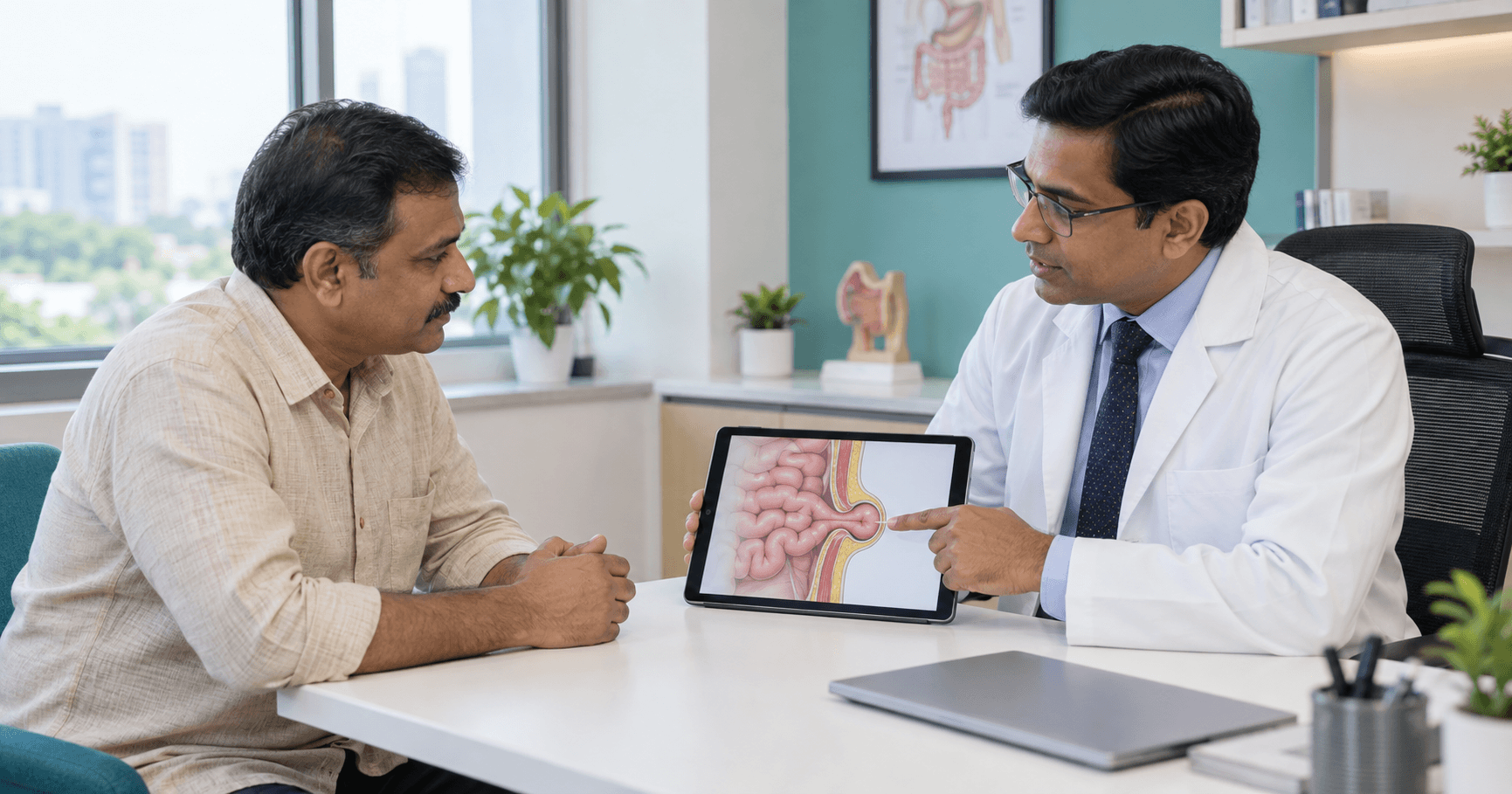
Can a hernia heal without surgery?
Most adult abdominal-wall hernias do not heal or close by themselves. Symptoms may become milder when you lie down, avoid straining or use temporary support, but the weak spot in the abdominal wall usually remains. A surgeon can confirm whether monitoring or planned repair is the safer path.
A hernia is tissue, sometimes fat or intestine, pushing through a weak area or opening in the muscle or connective tissue that normally contains it. A bulge disappearing while lying down means it may be reducible; it does not prove that the opening has healed.
Fast decision rule: a soft bulge with little discomfort may allow a planned consultation; a growing or activity-limiting bulge needs earlier review; a painful, stuck, red or dark bulge with vomiting or fever needs emergency care now.
Why can hernia symptoms improve even when the hernia has not healed?
Hernia discomfort can change with posture and abdominal pressure. A reducible bulge may flatten while lying down and return during coughing, standing, lifting or straining. That change can feel like recovery even though the abdominal-wall defect is still present.
NIDDK explains that an inguinal hernia may become more visible during coughing, straining or standing and may disappear when lying down: https://www.niddk.nih.gov/health-information/digestive-diseases/inguinal-hernia. Mayo Clinic similarly notes that the bulge may be more obvious while upright, coughing or straining: https://www.mayoclinic.org/diseases-conditions/inguinal-hernia/symptoms-causes/syc-20351547.
Do not judge risk from today's pain alone. Record where the bulge appears, whether it goes back in, what makes it larger, whether it is growing and whether it affects work, walking, bowel movements or sleep. This makes a surgical consultation more useful.
When can watchful waiting be discussed?
Watchful waiting may be discussed for selected adults with a confirmed hernia that causes little or no discomfort and is not showing urgent warning signs. It means planned monitoring with clear review triggers—not ignoring the hernia or assuming it has cured itself.
Decision guide: a comfortable, reducible bulge may suit scheduled assessment and monitoring; pain that limits normal activity, enlargement or difficult reduction needs earlier surgeon review; severe or rapidly worsening symptoms need emergency assessment. Women with a groin lump need timely evaluation because a femoral hernia can carry different risks.
The American College of Surgeons says watchful waiting can be an option for some adults with a reducible, not-uncomfortable inguinal hernia, while painful hernias often need surgical repair: https://www.facs.org/for-patients/the-day-of-your-surgery/adult-inguinal-and-femoral-groin-hernia-repair/. Decisions depend on hernia type, symptoms, examination, health, work and patient preference.
Can exercise, weight loss or a hernia belt repair the opening?
Exercise, weight management, constipation care and cough treatment may reduce strain or improve fitness, but they do not reliably close an adult abdominal-wall hernia. A belt or truss may offer temporary support for selected reducible hernias; it is not a permanent repair.
Do not start heavy abdominal exercise to push a bulge back or strengthen over it without medical assessment. Ask which activities are reasonable for your specific hernia and stop if an activity causes increasing pain, a stuck bulge, nausea or other worsening symptoms.
If you are considering support, read /articles/hernia-belt-for-inguinal-hernia-bhopal. If repair is being discussed, /articles/open-vs-laparoscopic-hernia-surgery-bhopal explains the questions that separate the two approaches, while /articles/hernia-mesh-repair-bhopal covers common mesh questions.
Which hernia warning signs need emergency care?
Seek urgent medical help for a bulge that suddenly becomes very painful, firm or stuck; red, purple or dark skin over it; vomiting; fever; abdominal swelling; inability to pass stool or gas; faintness; confusion; breathing difficulty; or rapid deterioration. Do not wait for a routine appointment.
NIDDK advises immediate medical care for symptoms that may indicate a stuck or strangulated inguinal hernia, including sudden severe pain, nausea or vomiting, fever, a bulge larger than before or no longer going back, redness and inability to pass gas or stool: https://www.niddk.nih.gov/health-information/digestive-diseases/inguinal-hernia. MedlinePlus also warns that a strangulated hernia needs urgent surgery: https://medlineplus.gov/hernia.html.
Call local emergency services or go to the nearest emergency department if these signs occur. Do not repeatedly force the bulge inward, delay care with a belt or self-prescribe medicine. The focused /articles/strangulated-hernia-symptoms-bhopal guide can help families recognise the red flags, but it must not delay emergency care.
What is the easiest next step for a stable hernia?
For a stable bulge without emergency signs, book a diagnosis-first consultation rather than trying multiple home remedies. The goal is to confirm the hernia type, understand whether imaging is needed, decide whether monitoring is reasonable and agree on symptoms that should change the plan.
Bring previous ultrasound or CT reports, operation notes, a medicine list, blood-thinner details and a short symptom timeline. Note whether the bulge reduces, how fast it is growing and which work, lifting or exercise duties matter. /articles/hernia-ultrasound-vs-ct-scan-bhopal explains why imaging is not identical for every patient.
For patients in Bhopal, Dr. Rajesh Kanungo evaluates groin, umbilical, incisional and other abdominal-wall hernias at R.K. Hospital, Indrapuri. Stable patients can review /services/hernia-surgery and /services/laparoscopic-surgery before booking through /contact; warning signs should use emergency care first.
Which medical sources support this guidance?
This article is general patient education, not a diagnosis, prescription, promise that monitoring is safe for you or replacement for examination. It was cross-checked against NIDDK inguinal hernia guidance at https://www.niddk.nih.gov/health-information/digestive-diseases/inguinal-hernia, American College of Surgeons groin hernia guidance at https://www.facs.org/for-patients/the-day-of-your-surgery/adult-inguinal-and-femoral-groin-hernia-repair/, Mayo Clinic inguinal hernia information at https://www.mayoclinic.org/diseases-conditions/inguinal-hernia/symptoms-causes/syc-20351547 and MedlinePlus hernia information at https://medlineplus.gov/hernia.html.
These sources support the same conservative conclusion: symptoms may vary, but most adult abdominal-wall hernias do not repair themselves; monitoring is suitable only for selected patients after assessment; and a painful stuck bulge or obstruction symptoms need urgent care.
Related care options
More patient guides
Tests Before Gallbladder Surgery: Ultrasound, Blood Tests and MRCP
Tests before gallbladder surgery commonly start with an abdominal ultrasound and selected blood tests. MRCP or other imaging is not routine for everyone; it may be considered when symptoms, liver tests or ultrasound raise concern about a stone in the bile duct.
Sleeping Position After Laparoscopic Surgery: A Safe Comfort Guide
There is no single sleeping position that is safest for every laparoscopic operation. Unless the surgical team gave a position restriction, use the position that lets you breathe comfortably and rest without pulling on wounds—often the back with support at first—then change position gradually as comfort allows.
Smoking Before Surgery: When Should You Stop?
Smoking before surgery can affect breathing, anaesthesia planning, wound healing and recovery. The useful next step is not to hide it or guess at a perfect quit date: tell the surgeon and anaesthesia team exactly what you use, how often, and when you last used it, then follow their written plan.
Common questions
Can a hernia repair itself naturally?
Most adult abdominal-wall hernias do not repair themselves naturally because the opening or weak spot remains. Symptoms may come and go, but a surgeon should confirm whether monitoring or repair is appropriate.
Can I live with a hernia without surgery?
Some adults with a confirmed, reducible and minimally symptomatic hernia may discuss watchful waiting. The decision depends on hernia type, symptoms, health, work and examination, with clear instructions for urgent warning signs.
Can exercise make a hernia go away?
Exercise may improve general fitness but does not reliably close an adult abdominal-wall hernia. Ask a clinician which activities are suitable and avoid exercises that cause increasing pain or make the bulge difficult to reduce.
When is a hernia an emergency?
A suddenly painful, firm or stuck bulge, skin colour change, vomiting, fever, abdominal swelling, inability to pass stool or gas, faintness or rapid deterioration needs urgent medical assessment.