
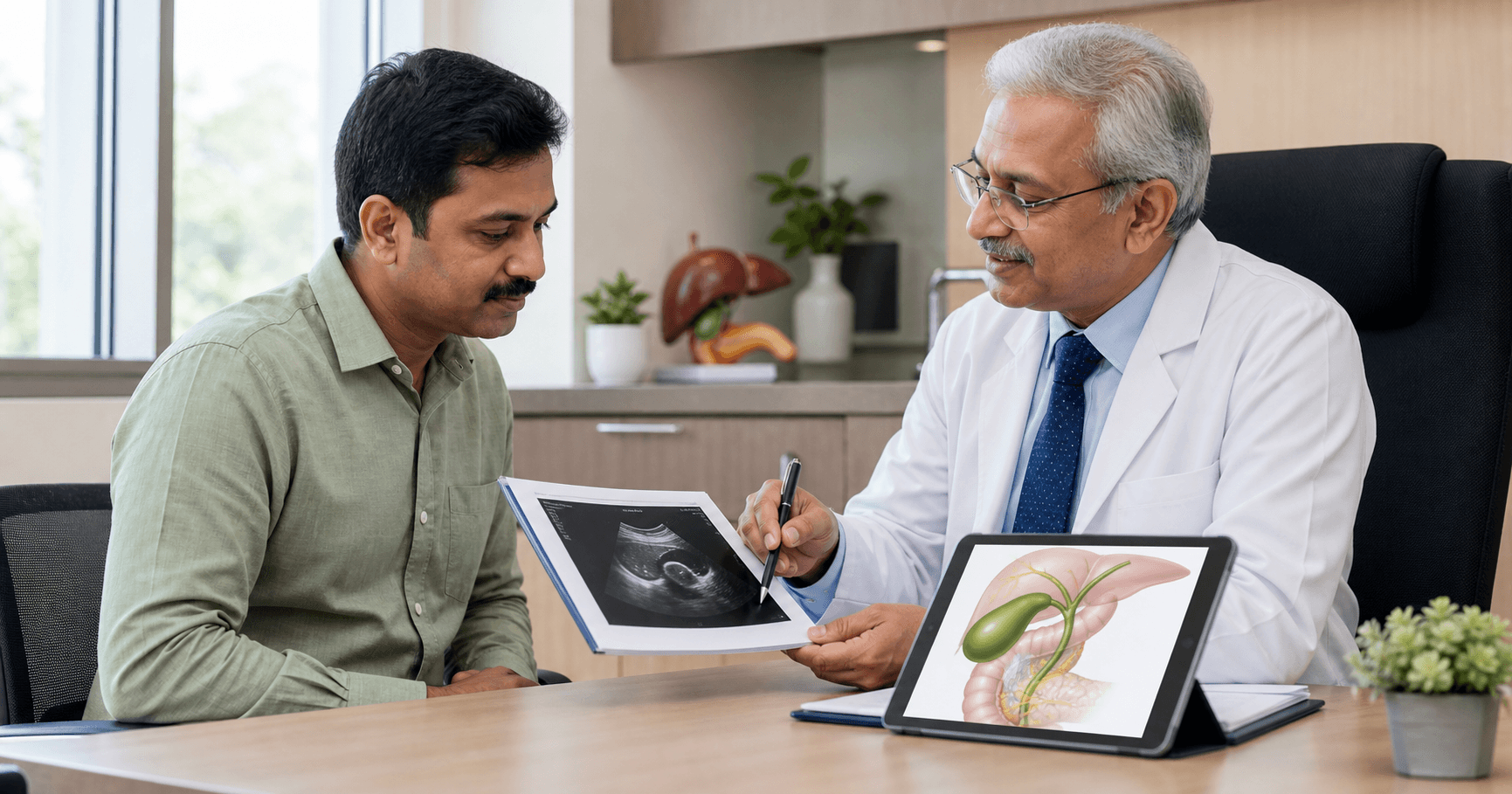
What does an ultrasound report showing gallbladder stones mean?
An ultrasound report showing gallbladder stones means the scan has seen stone-like material inside the gallbladder. It does not automatically prove that every stomach pain is from stones, and it does not automatically decide surgery by itself.
Ultrasound with gallstones is a report finding that must be connected with the patient story: pain location, timing after food, vomiting, fever, jaundice, blood tests, age, diabetes, heart risk, previous abdominal surgery and examination findings.
Fast decision rule: if the report says stones but you have no symptoms, book a planned medical review. If stones come with severe pain, fever, yellow eyes, repeated vomiting, fainting, confusion or a very unwell patient, use emergency care first.
Which ultrasound words matter during a surgeon consultation?
The words that matter are not only "stone present." A surgeon also looks for stone size or multiple stones, gallbladder wall thickening, tenderness over the gallbladder during the scan, fluid around the gallbladder, bile duct dilatation, sludge, polyps, liver findings and pancreas comments when mentioned. /articles/gallstone-size-surgery-needed-bhopal explains why a millimetre measurement alone does not decide surgery.
A practical report checklist is: gallbladder stones present, number or size if given, gallbladder wall thickness, common bile duct diameter, intrahepatic biliary dilatation, any cholecystitis comment, any pancreatitis concern, and whether the scan was limited by gas or incomplete fasting.
This checklist reduces wasted time. Instead of asking only "How many stones are there?", ask whether the ultrasound features and your symptoms suggest simple stones, inflamed gallbladder, bile duct concern, pancreatitis risk, another cause of pain or a need for additional tests.
How do symptoms change the meaning of gallstones on ultrasound?
Symptoms change the meaning because many gallstones are discovered incidentally, while others cause repeated attacks or complications. Right upper abdominal pain after oily meals, pain moving to the back or right shoulder, nausea, vomiting, fever, yellow eyes or dark urine all change urgency.
MedlinePlus explains that gallstones may cause abdominal pain, back pain, right shoulder pain, nausea or vomiting, and that pain often happens after meals: https://medlineplus.gov/gallstones.html. NIDDK explains that gallstones can block bile ducts and lead to pain, inflammation, infection or pancreatitis: https://www.niddk.nih.gov/health-information/digestive-diseases/gallstones.
This is why a report-only decision is weak. A patient with silent stones, a patient with monthly meal-related pain, and a patient with fever and jaundice may all have "gallstones" on ultrasound, but they need different levels of urgency.
When should a gallbladder ultrasound report be treated as urgent?
Treat the situation as urgent when gallstones on ultrasound are linked with severe or worsening upper abdominal pain, fever, chills, yellow eyes, dark urine, pale stool, repeated vomiting, dehydration signs, fainting, confusion, chest pain, breathing difficulty or a patient who looks very unwell.
Mayo Clinic lists severe abdominal pain, fever and yellowing of the skin or eyes as signs needing prompt medical care in gallbladder inflammation: https://www.mayoclinic.org/diseases-conditions/cholecystitis/symptoms-causes/syc-20364867. NHS guidance also describes gallstone complications such as gallbladder inflammation, jaundice and pancreatitis: https://www.nhs.uk/conditions/gallstones/.
Do not wait for a routine OPD appointment if these red flags are present. Call the treating doctor, go to emergency care, or use local emergency services first. This guide is patient education, not emergency triage or diagnosis.
What reports should you carry after ultrasound shows stones?
Carry the ultrasound abdomen report and films or images, liver function tests if done, CBC, bilirubin values, amylase or lipase if advised, blood sugar records, kidney function tests, ECG or physician notes if relevant, previous discharge summaries and a complete medicine list. For a plain-language explanation of when blood tests, MRCP or other checks may be considered, read /articles/gallbladder-surgery-tests-ultrasound-blood-mrcp-bhopal.
Also carry your symptom timeline: when pain started, where it was felt, whether it followed oily or heavy meals, whether it moved to the back or shoulder, how long it lasted, whether vomiting or fever occurred, whether eyes or urine changed color, and what medicines were already taken. The focused guide at /articles/gallbladder-attack-duration-emergency-bhopal explains how to record episode duration and when not to wait.
For Bhopal patients, Dr. Rajesh Kanungo reviews symptoms, examination findings, ultrasound, blood tests, medical fitness and previous surgery history before discussing observation, planned laparoscopic gallbladder surgery, open surgery, additional tests or urgent admission.
If you are unsure why a gallbladder ultrasound may lead to surgeon review rather than only digestive endoscopy, /articles/laparoscopy-vs-endoscopy-bhopal explains the laparoscopy versus endoscopy difference in plain language.
Does an ultrasound report decide laparoscopic gallbladder surgery?
No. An ultrasound report supports the decision, but the surgery discussion should include symptoms, examination, blood tests, complication signs, anesthesia fitness and patient-specific risks. A report can start the conversation; it should not replace a consultation.
NIDDK notes that the usual treatment for gallstones that cause symptoms is surgery to remove the gallbladder, while people without symptoms usually do not need treatment: https://www.niddk.nih.gov/health-information/digestive-diseases/gallstones/treatment. SAGES describes laparoscopic cholecystectomy as safe and effective for most suitable patients with symptomatic gallstones: https://www.sages.org/publications/guidelines/guidelines-for-the-clinical-application-of-laparoscopic-biliary-tract-surgery/.
Decision table: silent stones usually need planned review; repeated right upper abdomen pain after meals needs surgeon review; fever or jaundice with stones needs urgent assessment; bile duct dilatation or pancreatitis concern may need additional tests; major heart, lung, diabetes or blood-thinner risk needs medical and anesthesia planning.
What should you ask the surgeon after the report?
Ask whether your symptoms match gallbladder disease, whether the ultrasound suggests inflammation or bile duct concern, which blood tests are needed, whether laparoscopic surgery is suitable, what could require open surgery, and what warning signs should make you go to hospital immediately.
Also ask practical questions: do I need repeat ultrasound, LFT, CBC or pancreatitis tests; is this a planned surgery discussion or urgent admission; what is the expected hospital stay; what medicines should be discussed before surgery; and when should I call if pain returns at night? If the next question is the estimate, /articles/gallbladder-stone-surgery-cost-bhopal explains why cost depends on diagnosis, fitness, urgency and the planned approach. If you take aspirin, clopidogrel, warfarin, apixaban or another blood thinner, review the focused checklist at /articles/blood-thinners-before-gallbladder-surgery-bhopal before the visit.
A good consultation should leave you with a clear next step, not just a label. The outcome may be observation, more tests, planned laparoscopic gallbladder surgery, open surgery discussion, admission or emergency referral depending on the findings.
Which medical sources support this guide?
This article is patient education, not diagnosis, prescription, self-treatment advice or a replacement for examination. It was cross-checked against MedlinePlus gallstones guidance at https://medlineplus.gov/gallstones.html, NIDDK gallstones overview at https://www.niddk.nih.gov/health-information/digestive-diseases/gallstones, NIDDK treatment guidance at https://www.niddk.nih.gov/health-information/digestive-diseases/gallstones/treatment, Mayo Clinic cholecystitis warning signs at https://www.mayoclinic.org/diseases-conditions/cholecystitis/symptoms-causes/syc-20364867, NHS gallstones guidance at https://www.nhs.uk/conditions/gallstones/, and SAGES laparoscopic biliary tract surgery guidance at https://www.sages.org/publications/guidelines/guidelines-for-the-clinical-application-of-laparoscopic-biliary-tract-surgery/.
The consistent message is cautious and practical: gallstones found on ultrasound need to be interpreted with symptoms and medical review, symptomatic stones often need surgical discussion, and severe pain, fever, jaundice or repeated vomiting should be assessed urgently.
Related care options
More patient guides
Nail Polish Before Surgery: What Should Patients Remove?
Many hospitals ask patients to remove nail polish, gel or false nails before surgery because staff may need access to a natural nail for monitoring and assessment. The safest shortcut is simple: ask the hospital in advance, follow its written instruction, and tell the team if a product or item cannot be removed safely.
Piles Grades 1 to 4: What Changes at Each Hemorrhoid Stage?
Internal piles are graded by how far they prolapse, not simply by pain or bleeding. Grade 1 stays inside, grade 2 comes out and returns by itself, grade 3 usually needs manual reduction, and grade 4 remains outside. The grade helps structure a treatment discussion, but symptoms, examination and overall health still decide the plan.
Appendix Burst Symptoms: When Abdominal Pain Is an Emergency
A burst appendix is a medical emergency. Possible warning patterns include abdominal pain that becomes severe or spreads across the abdomen, marked tenderness, a swollen or rigid abdomen, repeated vomiting, fever, weakness, confusion or breathing difficulty. Pain may briefly ease before becoming widespread, so sudden relief does not prove the danger has passed.
Common questions
Does every gallbladder ultrasound showing stones need surgery?
No. Stones found without symptoms may need planned review rather than immediate surgery. Surgery is usually discussed when stones cause symptoms, repeated pain, inflammation, jaundice, pancreatitis concern or other complications.
What should I do after an ultrasound says gallstones?
Book a medical or surgical review and carry the ultrasound report, films, blood tests, medicine list and symptom timeline. Use emergency care first if there is severe pain, fever, jaundice, repeated vomiting, fainting or a very unwell patient.
Which doctor reads a gallbladder ultrasound report in Bhopal?
A general and laparoscopic surgeon can review gallbladder ultrasound findings along with symptoms, examination and blood tests, then explain whether observation, further tests, planned surgery or urgent care is appropriate.
Can ultrasound tell if gallbladder pain is urgent?
Ultrasound can show findings such as stones, wall thickening or bile duct dilatation, but urgency is decided with symptoms, examination and blood tests. Fever, jaundice, repeated vomiting or severe worsening pain should not wait.